Diseño web
Web Design vs. Web Development: What Is the Difference?
Equipo Artisma
Agencia de Marketing B2B
A business owner approves the budget for a web project and, months later, discovers he paid for two things he thought were one. The site looks the way he imagined, but it is slow, breaks on the phone and every minor change requires hiring the provider again. In the conversation to fix it, someone explains that the problem is on the development side, in the technical part nobody checked, and the business owner realizes he never understood the difference between the two. He hired someone who designed well but coded poorly, or the other way around, because to him web design and web development were the same word. That confusion is the most common cause of web projects that look good and work poorly, or work well and do not convert.
Web design defines how a site looks and how it is used: structure, experience and appearance. Web development technically builds that design with code so it works. They are two different disciplines, and a good project needs both working together.
Two Disciplines That Get Confused Because the Result Is a Single Site
The confusion between web design and web development is understandable: the end client sees a single product, the finished site, and does not distinguish the two disciplines that produced it. But they are different jobs, with different skills and often different people. Web design decides how the site looks and how it is used: the structure of information, the visitor journey, the appearance and the experience. Web development takes those decisions and builds them with code, so the site actually works in a browser, loads fast, adapts to any screen and does what the design promised. Understanding the difference matters because a project can fail on either side, and the business owner who does not distinguish which one failed does not know what they are hiring or what they are paying for.
An Analogy to See It Clearly
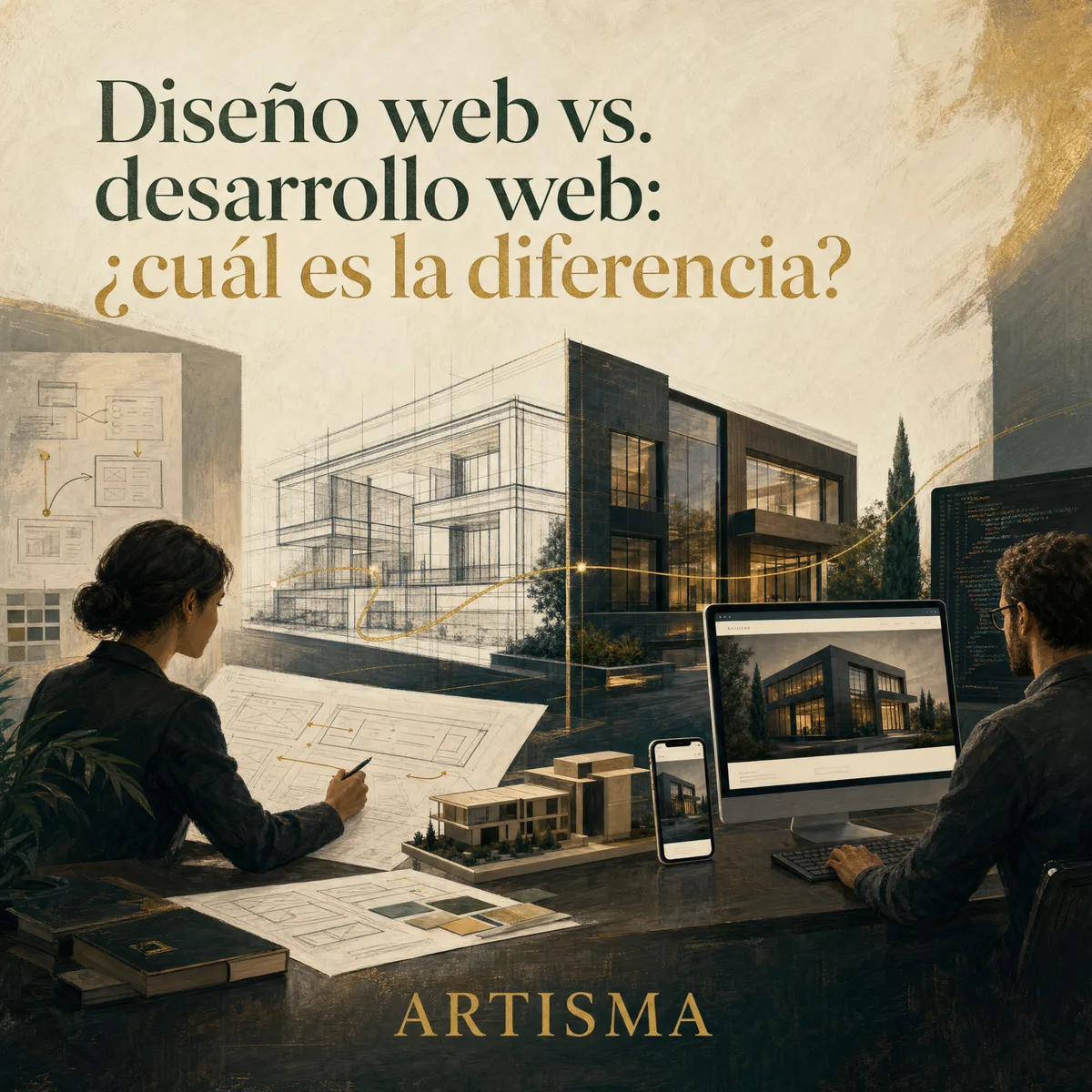
The simplest way to understand the difference is to think of building construction. Web design is the architect job: it decides how spaces are laid out, how people move through them, how the whole looks and how it feels to be inside. Web development is the construction company job: it takes those plans and builds them with real materials, makes sure the structures hold, the utilities work and the building is safe and solid. A beautiful plan poorly built produces a building that looks good but collapses; a flawless construction of a poorly thought out plan produces a solid building where nobody can find the exit. A good site, like a good building, needs both jobs done well and coordinated.
What Web Design Exactly Does
Structure, Experience and Appearance
Web design resolves the decisions that determine how the visitor is going to experience the site. It defines the information architecture, meaning how sections are organized and in what order the visitor finds what they are looking for. It defines the user experience, the journey a person takes from entering to acting, making sure each step is clear and frictionless. And it defines the appearance, which includes visual identity, the hierarchy of elements and aesthetic consistency. The result of web design is not yet a functional site, it is the complete blueprint of how that site should look, feel and behave. That blueprint is what development is going to build.
Why Good Design Is Thought Out Before Writing a Line of Code
Web design happens, or should happen, before development. Defining the structure, the journey and the appearance before programming avoids the most expensive mistake in a web project, which is building first and thinking later. When development starts without a clear design, every structural decision gets made on the fly, and correcting it later means rebuilding code that was already written. A well defined design gives development a blueprint to follow, reduces repeated work and makes the final site correspond to a business intent instead of the sum of improvised decisions. The order matters: first you decide what the site should do and how, then you build it.
What Web Development Exactly Does
Turning the Design Into a Site That Really Works
Web development takes the design blueprint and turns it into a real site through code. It is the work that makes the site load fast, look and work well on a phone, a tablet and a computer, makes forms send information where it needs to go and makes the site tools operate without failures. Development also handles what the visitor does not see but does experience: speed, security, stability and the site ability to grow without breaking. A well developed site feels solid and reliable; a poorly developed one looks like the design promised, but is slow, breaks on mobile or fails right when a prospect tries to contact you.
The Hidden Cost of Weak Development
Weak development has a cost that shows up after launch, when it is already hard to fix. A site built without technical care works in the initial demo and starts failing with real use: it becomes slow under traffic, breaks on certain devices, complicates any future update and leaves the business owner dependent on the provider for the smallest change. That cost does not show up in the initial proposal, it gets paid in the following months in the form of failures, slowness and maintenance bills. That is why evaluating a web project only by how the design looks leaves out half of what determines whether the site will work over time.
At Artisma we treat design and development as two parts of the same project, not as separate services you have to coordinate on your own. We design the structure, the experience and the appearance thinking about conversion, and we develop the site with the technical care that makes it fast, stable and easy to maintain, integrating the four tools of our B2B web redesign. We deliver the complete project in thirty days. If you want to see where your site stands today, you can request a free analysis and get it right away.
Frequently Asked Questions
Do I need to hire a designer and a developer separately?
You need both jobs done well and in a coordinated way, regardless of whether they are done by one person, a team or an agency. The risk of hiring them separately on your own is that coordinating between the two falls on you, and that is usually where problems appear: a design development does not respect, or development that ignores the design commercial intent. An agency that integrates both disciplines takes on that coordination as part of the project.
Which of the two is more important for my company?
Neither works without the other. Excellent design poorly developed produces a site that looks good and works poorly; solid development of a bad design produces a stable site that does not convert. The right question is not which matters more, but how to ensure both are done well and coordinated, because the business result depends on both.
How do I know if my current site problem is design or development?
As a general rule, if the site looks confusing, does not communicate your value proposition or the visitor cannot find how to move forward, the problem tends to be design. If the site looks good but is slow, breaks on the phone or fails when sending forms, the problem tends to be development. A professional analysis precisely distinguishes which side the failure is on before proposing any solution.