Diseño web
What Sets a Corporate Website Apart from an Online Store or Catalog?
Equipo Artisma
Agencia de Marketing B2B
The company's largest distributor calls the sales director to complain: one of his customers showed him, on a phone, the price of a valve listed in the online store the manufacturer launched two months ago, and that price is below the one the distributor works with after his margin. The site was built with a cart, a payment gateway and hundreds of products, because the web provider insisted that selling online was the natural next step. In eight weeks, a couple of small orders came in from individuals, while the purchasing managers at the plants, who generate almost all of the revenue, kept requesting quotes by email because they buy in volume, at negotiated prices and on credit. Today the company has a store nobody in its market uses, an open conflict with its distribution network and its price list in plain view of every competitor.
A corporate website builds trust and starts sales conversations; an online store closes sales with a public price and immediate payment; a catalog organizes products for reference. The right choice depends on how your customer buys.
Choosing your type of website based on trends or templates leaves your company selling with the wrong tool
The decision that weighs most on the results of a new website is often made without discussion: what type of site the company needs. A corporate website, an online store and an online catalog share technology, menus and appearance, which is why they are easy to confuse. Each one is built to trigger a different action from the visitor, and that action determines which pages it includes, what information it exposes and what work it demands from your team after launch.
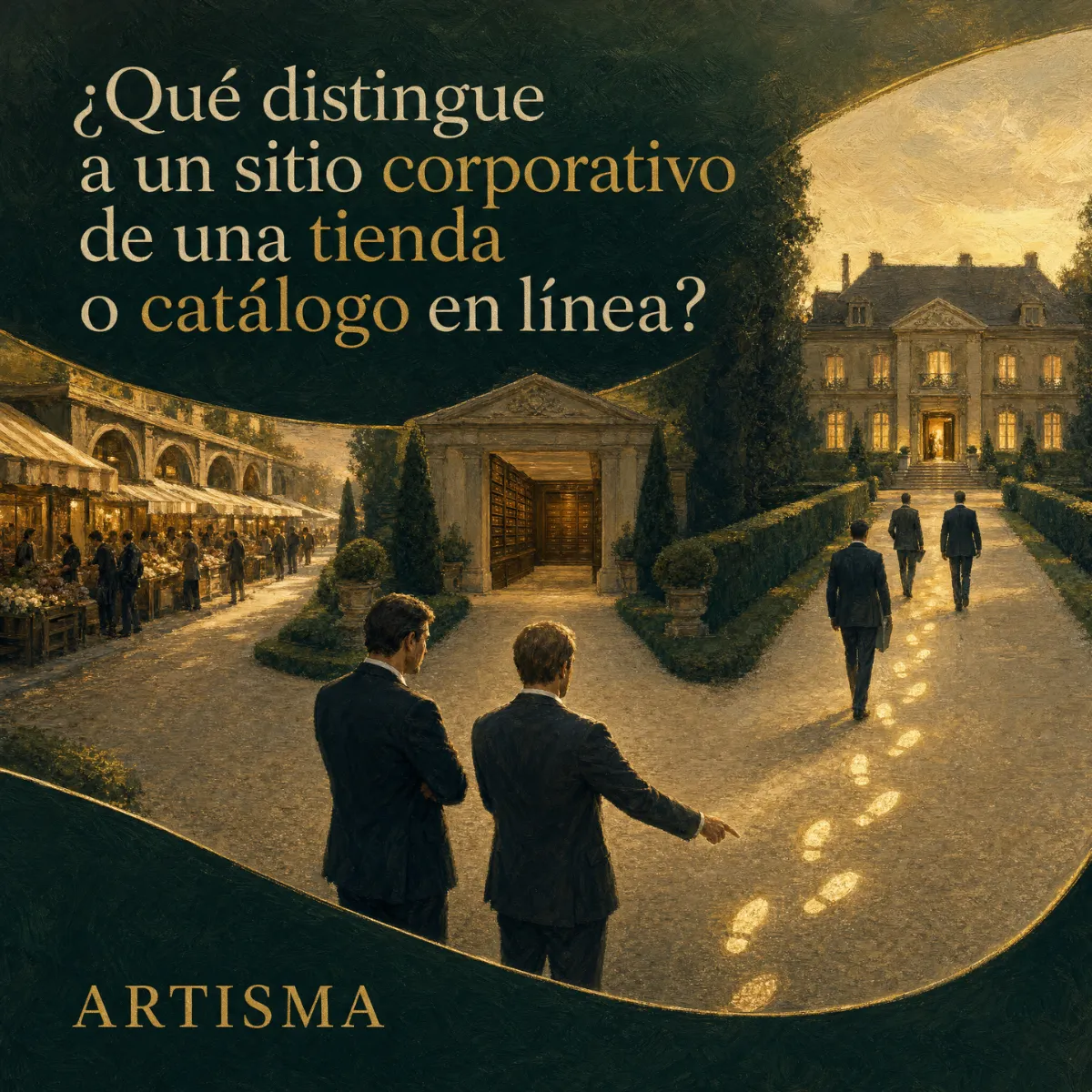
Summed up in one line per type: the online store is built for the visitor to buy right then; the catalog, for the visitor to find and look up a product; the corporate website, for the visitor to trust your company and start a conversation with your sales team. The useful question is which of those three actions drives your sales.
The conversion action: immediate purchase, product lookup or sales conversation
Every website is designed around one main action, which marketing calls a conversion. In a store, the conversion is the payment: the visitor adds products, enters an address and pays by card without talking to anyone. In a catalog, the conversion is less defined: finding the product and, at best, downloading a spec sheet or requesting information. On a corporate website, the conversion is the qualified contact: a meeting request, a call or a message with a name, a company and a need. When the site's main action clashes with the way your customers buy, the site can receive visits for years without contributing a single sale.
What an online store solves and what it exposes when your price depends on each customer
E-commerce works very well when three conditions are met: the product has a single price for any buyer, one person makes the decision and payment is settled on the spot. That is how consumers buy, and also how some business buyers purchase, for example when they restock low-value consumables, standard spare parts or office supplies.
Cart, payment gateway and public price: the mechanics of a transactional purchase
An online store rests on three pieces. The cart lets the visitor gather products and quantities; the payment gateway charges by card, bank transfer or another electronic method; and the public price gives the visitor the certainty needed to pay without asking. That third piece is the one that clashes most with B2B sales. If your company works with customer-specific price lists, volume discounts, credit terms or protected prices for your distributors, publishing them in an open store forces you to choose between showing a price that contradicts your agreements or hiding it, and a store without prices loses its reason to exist.
Inventory, shipping, invoicing and returns: the operation the store demands behind the scenes
The store also brings work the visitor never sees. The inventory you publish has to match the warehouse, every order needs packing, a shipping label and tracking, every sale requires an invoice with the buyer's tax information and returns call for a clear policy. For a manufacturer that ships by the pallet or by the full load, with its own logistics and its own lead times, setting up that operation for small orders can cost more than those orders bring in.
A standalone online catalog organizes your products and leaves the reason to choose you unanswered
The online catalog sits somewhere in between. It shows your offering organized by product family, with search, filters and a page for each product, without a cart or payment. It is the right tool when your line is broad and the buyer already knows what they are looking for: a part number, a size, a material. Well built, it saves your sales team many calls whose only purpose was to confirm whether you carry a certain product.
Families, filters and search: the lookup mechanism
A catalog's usefulness depends on how quickly it takes the visitor to the right product. That requires a family structure that reflects how the buyer thinks (by application, by material, by size), filters that narrow hundreds of options down to a handful and a search engine that understands the names the market uses.
The catalog's limit shows up when the buyer is still evaluating suppliers. A catalog answers what you sell and leaves open the questions that decide a contract: who you are, who you have worked with, what capacity you have and why it makes sense to trust you with a full year of supply. Published as a standalone site, the catalog turns your company into a list of products comparable to any other supplier's, and the comparison ends up on price.
The corporate website sells the trust a large purchase needs before the first call
The corporate website is built for the buyer who does not know you yet and has to justify to others why they should contact you. Its content revolves around the company: what problem it solves, which industries it serves, what capacity it has, which customers back its work and how a business relationship begins. In B2B sales, where a contract can represent months of supply and the cost of a bad choice falls on whoever recommended the supplier, that trust is worth more than the convenience of paying online.
Value proposition, capabilities and proof: what the corporate website puts at the center
Three blocks hold up a corporate website. The value proposition explains in one sentence what result your customer gets and why with you. The capabilities describe processes, facilities, geographic reach and services in enough detail for a buyer to confirm or rule out whether you can serve them. The proof brings together case studies, customers, current certifications and track record, everything that reduces perceived risk. The center of gravity is the company and its ability to deliver.
The corporate website's conversion: bringing the visitor to a conversation with sales
Since the end goal is a conversation, the corporate website needs clear paths to it on every page: a short form, a WhatsApp button, click-to-call or a scheduler to book a meeting. A well-built corporate website works like a salesperson on duty day and night, introducing your company, screening prospects and handing sales the ones that fit your offering.
How to decide which type of website your company needs before you request quotes for the project
The answer comes from observing how your best customers buy today. Before you ask for proposals, go over these questions with your sales team:
Are your prices the same for every buyer, or do they depend on volume, the customer and negotiated terms?
Does one person decide the purchase, or does it go through purchasing, engineering, quality and management?
Does your customer pay when ordering, or work with you on credit, purchase orders and periodic invoicing?
Is your product line so broad that the buyer needs to search and filter to find what they want?
Do you also sell through distributors whose prices and territories you need to protect?
If your prices are fixed, the decision is individual and payment is immediate, an online store makes sense. If the buyer already knows you and needs to find a product within a broad line, a catalog does the job. If the sale depends on negotiating, convincing several people and building a relationship, the corporate website is the foundation, and the catalog or the store can be added as modules.
Combined models: the catalog inside the corporate website and the store only for the replenishment line
Many B2B companies need more than one format. A manufacturer can have a corporate website that presents its capacity and, within it, a product catalog without prices where every product page ends in a quote request. An industrial consumables company can add a store limited to fixed-price replacement parts, while supply contracts continue through the sales channel. Each format needs its own goal, visible to the visitor.
At Artisma we design corporate websites for B2B companies and connect them to each client's sales process: calls to action in every section, a WhatsApp button, click-to-call, a form and a virtual assistant that answers frequently asked questions and captures visitor information for your CRM. Before proposing a format, we review how your company sells today, because the type of website is defined by the way your customer buys.
Frequently Asked Questions
Can I publish prices on my corporate website without turning it into a store?
Yes. Some companies publish reference prices or ranges to screen out prospects who do not fit their budget, without a cart or online payment. It is worth doing only if those prices apply to any buyer and respect your agreements with your distributors; if your price depends on volume and on each account's terms, the better approach is to invite visitors to request a quote.
Does a downloadable PDF catalog replace an online catalog?
They serve different purposes. The PDF lets the buyer share it within their company or consult it offline, but Google treats it as a single document and the visitor has to download a heavy file to find one piece of information. The recommended approach is to have your products as pages on the site and offer the PDF as a complement.
When does it make sense to add an online store to my corporate website?
When a significant share of your sales already happens at a fixed price, is decided by one person, is paid on the spot and your operation can fulfill small orders quickly. In that case, the usual approach is to add the store as a section of the corporate website focused on that line.
If your company is about to renew its website and the first proposal you received includes a cart and a payment gateway without anyone asking how your customers buy, it is worth pausing before you sign. Request a diagnosis of your site at https://www.artismamkt.com and we will review with you what type of website your way of selling needs and which sections would give your sales team more conversations.