Email marketing
What Is Email Marketing and How Do You Structure an Effective B2B Campaign?
Equipo Artisma
Agencia de Marketing B2B
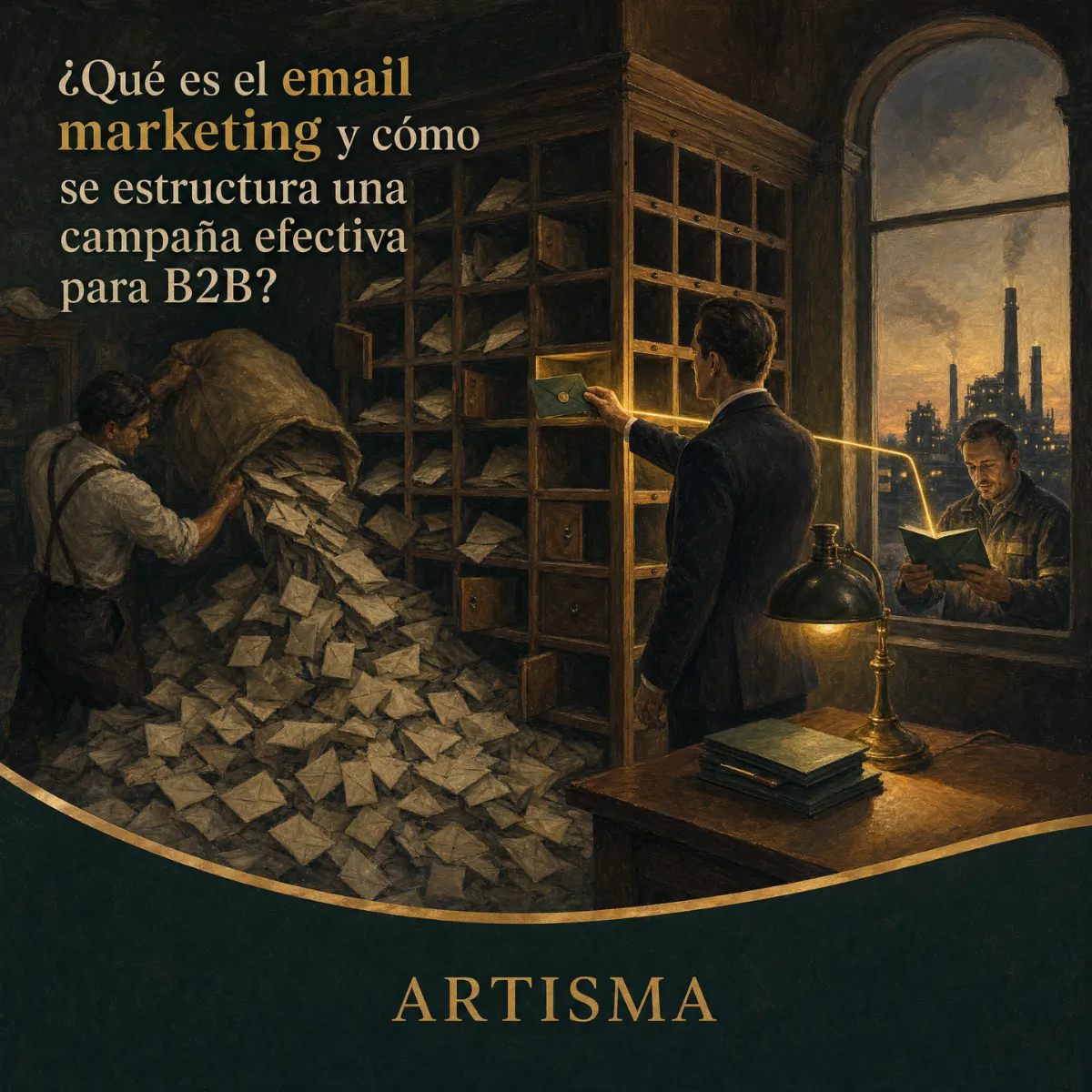
The marketing manager at an industrial equipment manufacturer gathers into one file the contacts from the CRM, from the latest trade shows and from the business cards the sales team collected over the years: several thousand addresses. She sends all of them the monthly promotion on the same Tuesday. Within two weeks, dozens of people unsubscribe, several recipients mark the email as spam and even the quotes and invoices the sales team sends from the same domain start landing in the junk folder. Among those contacts was the maintenance manager who had requested a quote eight months earlier; he received an offer for equipment his plant does not use, and that same month he signed with the competitor that had sent him a technical guide on his problem. A database that took a decade to build was damaged in a single send.
B2B email marketing is email communication with contacts who agreed to receive it. An effective campaign starts from a business goal, segments the database, sends messages with a single purpose and measures opportunities in the CRM.
Sending the same email to your entire database wears down a sales asset your company took years to build
Email marketing is the email communication your company maintains with contacts who already know it and who agreed to receive its messages: current customers, prospects who filled out a form, webinar attendees, visitors who downloaded a guide. In a B2B sale, its role is to sustain the relationship during the months between the first contact and the purchase order, and to reopen the conversation with customers who have already bought. Well structured, it gives your sales team a reason for every call and reminds the buyer who understands their problem best when the time comes to decide.
Your own database and consent: the line that separates it from cold email
We have already covered cold email on our blog: it seeks to open a conversation with someone who does not yet know your company. Email marketing works on the other side of that line: the recipient has already been in contact with you and has given permission to receive information. That is why it is sent to segments of your database, at an agreed frequency, with a recognizable design and a visible option to unsubscribe. Loading people who never gave you permission into your newsletter is the fastest way to make email providers stop trusting your domain.
Newsletter, campaign and sequence: three formats with different goals
Three formats that are often confused coexist within email marketing. The newsletter is periodic and maintains presence with technical articles, product news or application cases. The campaign has a single goal and an end date: inviting people to a webinar, introducing a new line or reactivating customers who stopped buying. The nurture sequence is a series of emails that starts when a contact takes a specific action and guides them toward the next stage of the purchase. We explain how those sequences work in our article on marketing automation; here we focus on campaign strategy.
Why so many B2B emails reach the inbox and still go unopened
A plant's purchasing manager receives dozens of sales emails every week and decides in seconds which ones to open. The ones that get discarded talk about the sending company instead of the recipient's problem, have a subject line any supplier could sign and ask for an action the reader is not yet ready to take.
The buying committee reads the same email with different questions
Several people take part in an industrial purchase, and each one opens the email looking for something different. Engineering wants specifications, compatibility and operating conditions. Purchasing looks for lead times, commercial terms and confirmation that your company can sustain supply. Management needs to know what risk you reduce and how much it costs to keep living with the problem. A single newsletter for all three ends up diluted; three versions of the same message, each with its reader's angle, increase the likelihood that the email gets forwarded and moves forward inside the buying company.
Sender reputation: authentication, list cleaning and complaints
Email providers decide with every send whether your message goes to the primary inbox or to the junk folder, and to do so they check three things. The first is domain authentication with the "SPF", "DKIM" and "DMARC" records, which prove the email came from a server your company authorized. The second is list hygiene: addresses that bounce again and again reveal a database nobody maintains. The third is how recipients react, where spam complaints count against you and replies count in your favor. Cleaning the database before every campaign also protects the emails that carry quotes, purchase orders and invoices.
The structure of a B2B email marketing campaign that ends in conversations with sales
An effective campaign is built in a fixed order, and each piece depends on the one before it.
A measurable business goal before writing the first subject line
Every campaign starts with a question: what should happen in your sales process when it ends. It can be a number of scheduled meetings, quote requests, inactive customers who order again or webinar registrations. That goal defines who receives it, what is offered and how the result is measured. A campaign whose goal is "maintaining presence" can work as a newsletter, but it will hardly justify its cost to management when the budget review comes around.
Segmentation by buying stage, industry and job title
With the goal clear, the database is divided into groups that need different messages. The three cuts that pay off most in B2B are the buying stage (who is researching, who has already requested a quote, who buys on a recurring basis), the industry or application, and the role within the committee. We explain how to define those groups in our article on market segmentation; in email marketing they are applied as tags in your CRM, and every campaign is only as good as those tags.
A message with a single idea and a single call to action
Each email in the campaign carries one idea and one action. The subject line previews the concrete benefit for the reader, the first paragraph names a problem the reader recognizes as their own, the body provides a useful piece (a guide, a technical comparison, an application case, an invitation) and the closing asks for a single step: download, register, schedule or reply. An email signed by a person with a name and job title invites a reply more easily than one signed by a department. The design should be clean and readable on a phone, even if the images do not load.
A cadence that respects your market's sales cycle
Frequency is set by your market's buying pace and by what you have to say. A manufacturer with sales cycles of several months can sustain a monthly newsletter and occasional campaigns around launches or trade shows; sending every week without new content only speeds up unsubscribes. A quarterly calendar reviewed with sales keeps the campaign from colliding with sales reps' visits to the same accounts.
Measurement connected to the CRM: from open to opportunity
The open rate has lost reliability as an indicator: some email programs download images automatically to protect user privacy, and that records opens nobody made. The indicators that do guide decisions are clicks on the call to action, replies, unsubscribes and complaints by segment, and above all how many campaign contacts became opportunities in your CRM. When each contact keeps the source of its record and the history of the emails it received, management can compare email marketing with the other channels in the same units: opportunities opened, sales closed and cost per new customer.
A purchased list leaves your campaign exposed to complaints, bounces and legal problems
The temptation to speed things up with a purchased list appears in almost every company that starts with email marketing, and its cost arrives quickly: invalid addresses, spam complaints, a damaged sending reputation and a possible breach of Mexican personal data protection law, which requires informing the data subject, through a privacy notice, of how their data will be used. A healthy database grows with contacts who raised their hand and know why they receive your emails.
The capture points that feed a permission-based database
The most valuable contacts arrive through paths your company controls: the quote form on your website, a technical guide the visitor receives in exchange for their information, a webinar registration, a conversation with the virtual assistant and sign-ups at your trade show booth, always with a clear checkbox asking for permission to send information. Each capture point should record in the CRM the contact's source and the topic that interested them, because that tag determines which segment they enter and which sequence they receive first.
At Artisma we build the website side that feeds your email marketing: calls to action connected to the funnel, a form and a virtual assistant that send visitor information to your CRM with its context, and visitor analytics to know which topics attract each segment. The weekly SEO blog, as an add-on module, produces the technical material that later feeds newsletters and sequences, and cold email is handled separately to open conversations with companies that are not yet in your database.
Frequently Asked Questions
How often should I email my customer and prospect database?
It depends on your market's buying cycle and on how much useful content you can produce. For most B2B companies, a monthly newsletter plus occasional campaigns around launches, events or seasons is a reasonable baseline. If unsubscribes and complaints rise after every send, the frequency exceeds what your database wants to receive or the content has stopped being useful to it.
Can I load trade show contacts or a purchased list into my database?
Trade show contacts, only if they were told when they registered that they would receive your emails and they agreed. In that case, it is best to first send them a welcome message that reminds them where you met and offers the option to unsubscribe. A purchased list lacks that permission, brings invalid addresses and exposes your domain to complaints that affect all your sends, including sales emails.
What is the difference between email marketing and marketing automation?
Email marketing is the channel: the strategy, the database, the messages and the calendar of your emails. Automation is one way to execute it, with rules that send emails and record activity based on each contact's behavior. You can do email marketing with manually scheduled campaigns; automation makes sense when the volume of contacts exceeds what your team can handle with manual follow-up.
If your company keeps a contact database it only uses to send promotions or year-end greetings, there are stalled sales conversations sitting in it. Request a diagnosis of your site at https://www.artismamkt.com and we will review with you how contacts reach your CRM today, with what permission and with what information, so your next email campaign works on a database that wants to read you.