Account-based marketing
What Is Account-Based Marketing (ABM)?
Equipo Artisma
Agencia de Marketing B2B
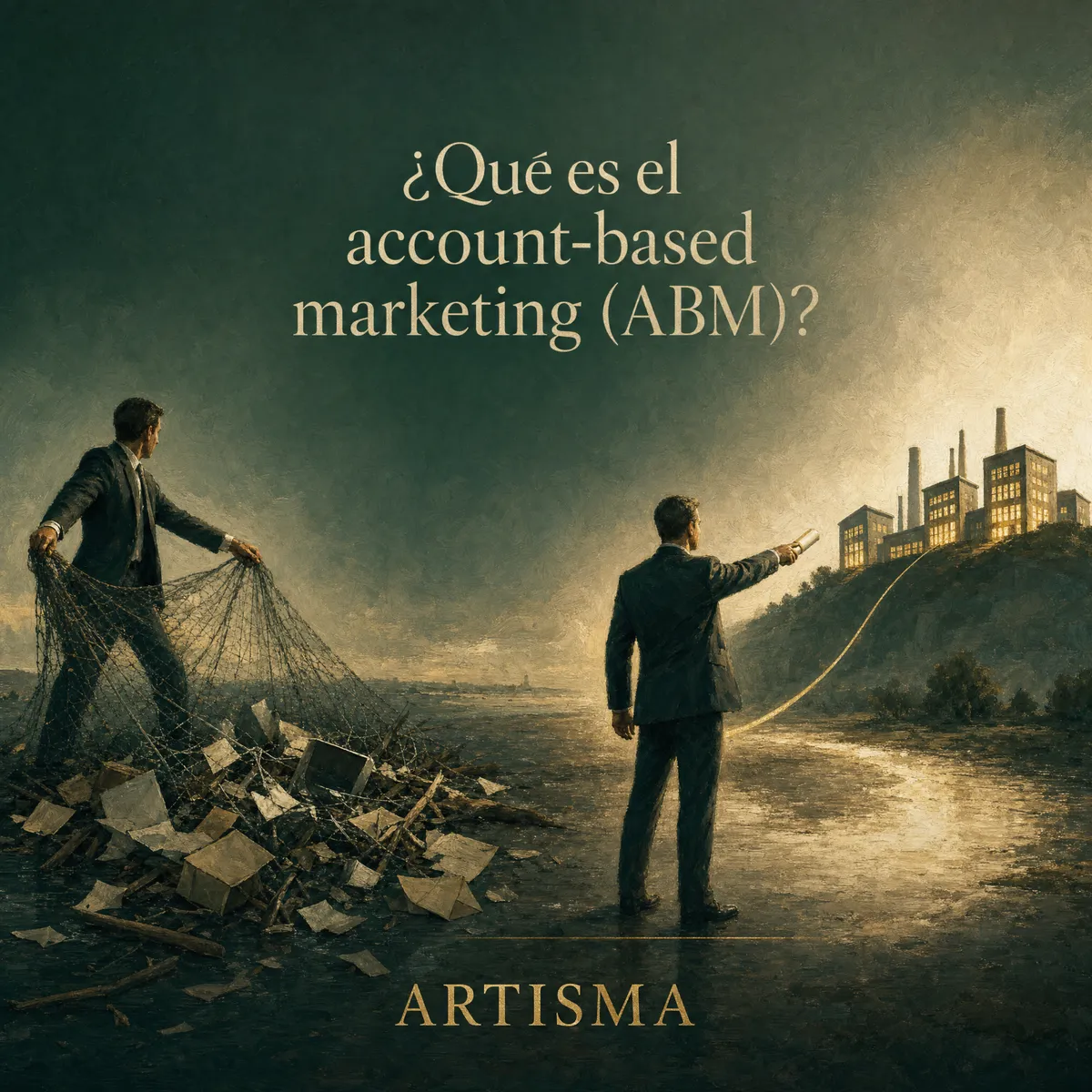
Your company sells a product that only about two hundred plants in the country buy, and the marketing strategy is the same one an online store would use: open ads, content for everyone and a form waiting for someone to show up. In six months hundreds of contacts arrived and none of them were from those two hundred plants. Meanwhile, the one account sales actually wanted to open received the same generic email as everyone else, and did not reply.
ABM reverses the logic of mass marketing: first you choose the accounts your company wants to win, and then you design, for each one, the content and the outreach its buying committee needs.
When the market fits on a list, the open funnel wastes
Traditional marketing works like a net: you cast it wide and wait for something to land. That logic makes sense when the market is thousands of anonymous buyers. When your market is two hundred plants with a known name, address and purchasing manager, the net catches noise and lets through exactly the companies that matter. Account-based marketing starts from the list and works inward.
The cost of talking to ten thousand to reach two hundred
Every peso you spend on a click from someone who is not on your list is budget that never comes back, and every hour sales spends qualifying out-of-market contacts is a call that was not made to a target account. In concentrated markets, the open funnel produces reports with many leads and few opportunities, and the conversation with management ends in the question of why the pipeline is not growing if marketing "works".
How ABM works in practice
ABM runs in three steps that repeat account by account: select, map and activate. None of the three is a mass campaign; all three are joint work between marketing and sales on a shared list.
Account selection: criteria and list
The list is built with written criteria: industry, process, volume, location, installed technology and potential value. That yields between twenty and one hundred accounts, depending on the size of your sales team, ranked by priority. A list of five hundred "target" accounts is a list of nobody; one of forty with an assigned owner is a work plan.
Map of the buying committee: who decides, who influences, who blocks
In an industrial plant, the purchase of a material or a service passes through several hands: the production manager who suffers the problem, the quality manager who validates, the buyer who negotiates, the director who signs and, sometimes, the engineer who already has a supplier and would rather not change. ABM identifies each of them by name and role, and decides what message each one needs, because the argument that convinces production is not the one that convinces purchasing.
Content and outreach tailored to each account
With the map in hand, marketing produces material that speaks to that account's specific process: a page for its industry, a case from a similar plant, an adapted value proposition, a LinkedIn message that mentions its production line. Sales uses that material in the outreach sequence, and both teams log every interaction with every committee member in the CRM. The result is an account that receives five coherent pieces instead of one generic email.
The three tiers of ABM and which one fits your team
The one-to-one tier dedicates exclusive content and outreach to each account; it is reserved for the five or ten accounts that can change the company's year. The one-to-few tier groups accounts with the same process or the same industry and produces material by group; it is the one that works best for most mid-sized industrial companies. The one-to-many tier uses the list to steer targeted digital campaigns and industry pages; it is the entry point when the team is small. Choosing the tier according to the team you have, and not the one you wish you had, decides whether the program survives the first quarter.
The three tiers coexist. A company can work its five strategic accounts one-to-one, the three industry groups that concentrate its market one-to-few, and the rest of the list one-to-many with targeted campaigns. What changes between tiers is the amount of exclusive content per account and the salesperson time dedicated to each one; what does not change is that all of them come from the same list and are measured with the same metrics.
What an ABM program looks like at a supplier plant
A company that manufactures packaging for the automotive industry had a market of about one hundred and fifty plants and assemblers in the country. Its marketing consisted of generic ads and a blog for "industry". When it moved to ABM, sales and marketing jointly built a list of thirty-five priority accounts, with one salesperson responsible for each, and mapped at every plant the logistics manager, the quality manager and the buyer.
Marketing produced three pieces per account group: a page per type of process, a documented case from a comparable plant and a proposition adapted to each account's line. Sales used them in an outreach sequence on LinkedIn and email aimed at each committee member, with every interaction logged in the CRM. In the first quarter they secured meetings with a third of the list; in the second, two of those accounts went into product trials. The monthly lead report, which used to look good, stopped mattering.
What your company needs before starting
ABM is a way of working, and before starting it demands four conditions. A CRM where the account list, the committee members and every interaction live. A website with pages by industry or by process to send each account to. A company LinkedIn profile that sustains the conversation when the committee does its research. And a written value proposition, because tailored content is adapted from it.
The website as a piece of the program
When a committee member receives a tailored message, the first thing they do is visit the site. If they find a generic page, the effort of the outreach is lost right there. A site prepared for ABM has pages by industry and by process that every message can link to, cases with the sector named, and a form or a capture assistant that recognizes the account and alerts the responsible salesperson within minutes. The site stops being a brochure and becomes the place where the committee confirms what the salesperson told them.
Marketing and sales on the same list
The condition that breaks the most ABM programs is the separation between marketing and sales. If marketing produces content for accounts sales does not pursue, or sales contacts accounts marketing did not prepare, the effort is duplicated and the buying committee receives crossed messages. There is one list, each account has an owner, and it is reviewed in the same weekly meeting.
How ABM is measured
ABM is measured by account, not by lead. The metrics that matter are how many accounts on the list show real engagement, in how many a meeting with a committee member was secured, how many advanced a stage in the pipeline and how much what advanced is worth. A program that reports "leads generated" measures with open-funnel logic and cannot see whether the two hundred plants are moving.
At Artisma we design ABM programs for industrial companies that sell to concentrated markets, with the CRM, the site and the content connected so marketing and sales work on the same list of accounts.
Frequently Asked Questions
Does ABM replace content marketing and campaigns?
It redirects them. Content stays, but it is produced for the accounts on the list and for their industry; campaigns stay, but aimed at those accounts and those roles. What disappears is the spend on reaching people who are not in the market.
How many accounts should the list have to start?
As many as your sales team can genuinely work in a quarter. For a team of two or three salespeople, between twenty and forty priority accounts with an assigned owner. Expanding the list is easy; sustaining it is the hard part.
How long does it take to show results?
The first meetings with target accounts usually arrive in the first quarter; pipeline progress is read at six months, because industrial buying cycles are long. Measuring it by monthly leads leads to abandoning it too early.
If your market fits on a list and your marketing still casts the net at everyone, the accounts that matter receive the same message as the ones that do not. Request a diagnosis of your strategy at https://www.artismamkt.com and we will build the list, the map and the content for the plants your company wants to win.