Generación de leads
What Is a Webinar and How Do You Use It to Generate B2B Leads?
Equipo Artisma
Agencia de Marketing B2B
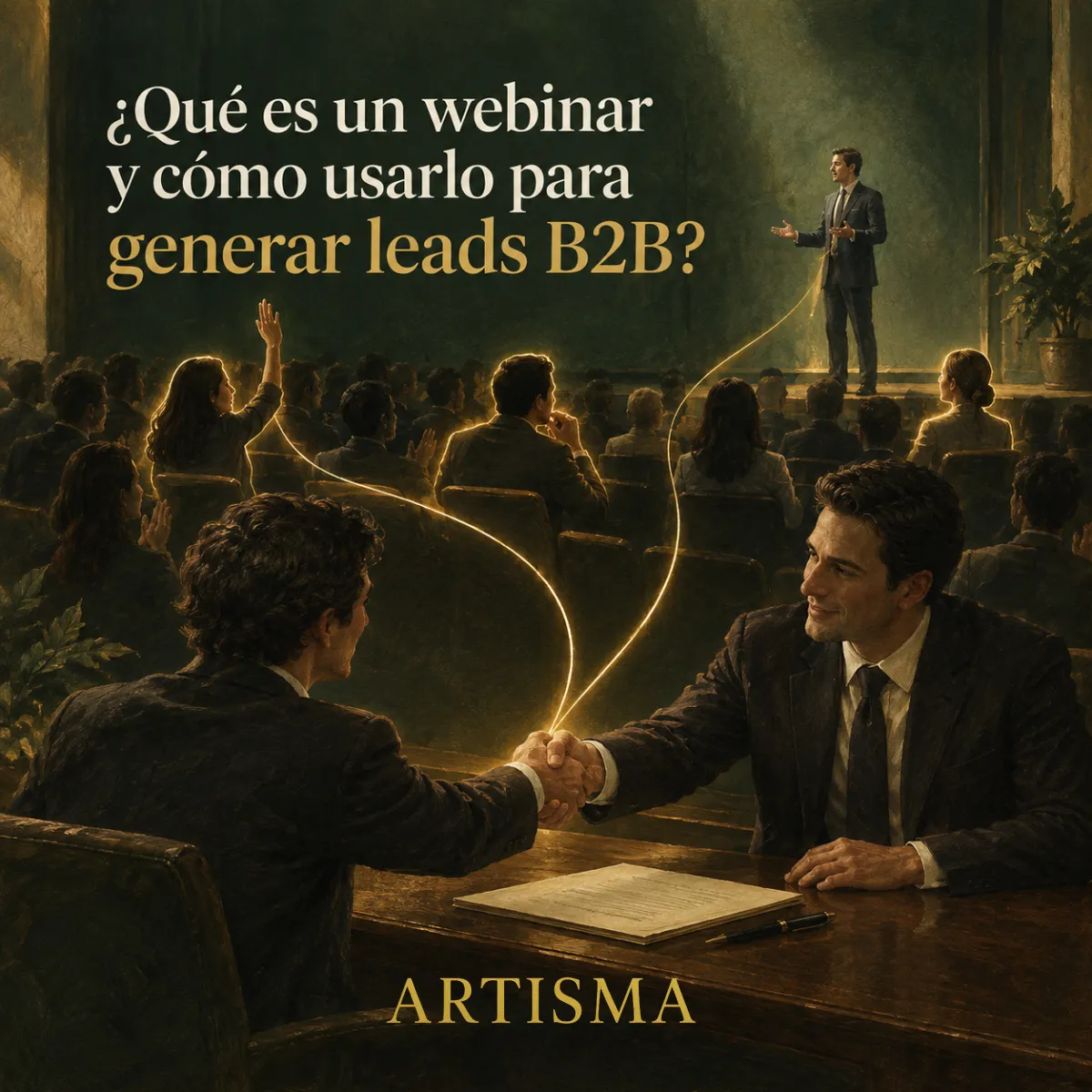
Your company hosted its first webinar on the problem that worries your customers most this year. More than a hundred people registered, the technical director spent two weeks preparing the presentation and the session went flawlessly. Fewer than half of the registrants logged on, the chat questions ended up in a screenshot nobody opened again and the attendee list stayed on the streaming platform. Three weeks later, when a salesperson finally called the attendee who had asked about delivery times, the answer was brief: they had already signed with another supplier, the one that called them the day after its own event.
A webinar is a live online presentation where your company teaches something useful in exchange for the attendee's contact details. It generates B2B leads when the topic attracts your buyer and sales follows up that same week.
A webinar without a sales plan earns applause and zero quotes
A webinar, or web seminar, is a live presentation streamed over the internet to a group of people who registered in advance to attend. It has four pieces: a registration page, the live session with time for questions, the recording and the follow-up. The first three are the ones almost every company takes care of; the fourth is the one that turns the session into prospects, and it is also the one that most often ends up without an owner.
For a B2B company, the webinar has an advantage few formats can match: the attendee hands over their details and also an hour of attention. Someone who downloads a document may never open it, while someone who stays forty minutes listening to your technical director explain a problem in their industry has already given you a much stronger signal of interest. In a previous article we explained what a lead is and how to tell a cold contact from a qualified one; a well-planned webinar lets you make that distinction with behavioral evidence instead of assumptions.
The buying committee in the same room
B2B purchases are rarely decided by a single person. In an industrial plant, engineering, purchasing, finance and leadership usually weigh in, and each one researches on their own before sitting down with a supplier. A webinar lets several people from the same company hear your complete argument, in your own words and without the filter of a forwarded email. When two or three names from the same account appear on the registration list, sales has a clue that no contact form would ever provide.
The three mistakes that empty the room before the stream begins
Most webinars that fail as a sales tool do so before event day. There are three causes we see again and again, and all three can be fixed during planning.
A topic conceived from your company's catalog
A webinar titled "Discover our new product line" attracts current customers and curious competitors. One titled after the problem your buyer faces this quarter, for example how to reduce maintenance downtime or what changes with a new industry regulation, attracts people who have that problem and still do not know who to solve it with. The product appears in the session as part of the solution, at the moment the attendee already understands why they need it. A good starting point for choosing the topic is the set of questions your sales team answers over and over in first calls.
A registration page that asks too much or promises too little
The registration page works like a landing page with a single goal, and the same rules we explained when we covered landing pages apply to it: a headline that repeats the promise of the invitation, what the attendee will learn in three or four concrete points, who is presenting and why they are worth hearing, date and time with the time zone, and a short form. Name, company, job title and email are usually enough; one additional question about the attendee's main challenge gives you qualification data without slowing down registration.
A promotion of just a few days with a single reminder
Announcing the webinar a week ahead and sending a single email on the day leaves the room half empty. Executives plan their calendars in advance, so promotion works best when it starts three or four weeks out and combines channels: LinkedIn posts from the company and the speakers, an email to your contact base, personal invitations from each salesperson to their priority accounts, a reminder the day before and another one an hour before the start. A personal invitation from a salesperson usually carries more weight than any ad, because it comes from someone the prospect already knows.
How to turn the live hour into buying signals
During the broadcast, your company has the attention of prospects who chose to be there. That hour serves to teach and also to gather information that later organizes the work of your sales team.
Polls and questions as a qualification filter
One or two short polls during the session, such as "What stage is your project in?" or "Which of these problems affects you most today?", give attendees a comfortable way to participate and give your team a qualification data point with every answer. Chat questions are worth even more: someone who asks about delivery times, compatibility with their equipment or contract terms is thinking about buying. Every question should be recorded with the name of the person who asked it, because during follow-up it is the best reason for a call.
Scoring each attendee by behavior
The streaming platform records who registered, who logged on, how long they stayed and who participated. With that data you can build a simple score: registrant who did not attend, attendee who left halfway, attendee who stayed to the end and attendee who also asked a question or answered the poll. That classification, cross-referenced with the company profile, defines whom sales calls first and whom marketing emails.
Follow-up in the first 48 hours decides whether the webinar sold anything
The interest a good session generates cools quickly. If follow-up arrives two weeks later, the attendee has already forgotten the details, and the most advanced prospects may have already talked to another supplier. That is why it pays to have the follow-up written before the broadcast, with owners and dates, and to launch it within the following two days. The message changes according to each attendee's score:
Attendees who asked questions or said they have an active project: a call or personal message from the assigned salesperson, referring directly to their question.
Attendees who stayed to the end: an email with the recording, the supporting material and a concrete invitation to a diagnostic meeting.
Attendees who left halfway: the recording with a timestamp for the part they missed.
Registrants who never logged on: the recording and an invitation to the next session.
Form, CRM and automation connected before the event
All of the above breaks down if the registration list lives on the streaming platform or in a spreadsheet someone exports whenever they remember. The registration form should send each contact straight to the CRM, tagged with the webinar, and marketing automation should trigger the reminders and follow-up emails without manual work. That way sales sees in its own tool who attended and what they asked, and the history stays available for the next conversation.
The recording as an asset that keeps capturing leads
Once the session is over, the recording can keep generating registrations for months if you publish it on your site with a short form to watch it. The same hour of content yields short clips for LinkedIn, a blog article built on the audience's questions and material sales can share in its conversations. A well-recorded webinar feeds several weeks of content with work your team has already done.
What to measure to know whether the webinar produced business
The number of registrations and the attendance rate help you adjust the promotion and say little about the business the session generated. The metrics leadership cares about are measured in the CRM over the following weeks: how many attendees match your ideal customer profile, how many meetings were booked, how many opportunities were opened and for what amount, and how much each one cost. In a previous article we explained how to calculate cost per lead; for a webinar it pays to carry that calculation through to cost per opportunity, because the B2B cycle can take months to turn an attendee into a customer.
At Artisma we work on the part of the webinar that connects to the sales process: the registration page, the form integrated with the CRM, the measurement of visitor behavior and the content derived from the recording. Your team brings the topic and the expertise, because it knows your customer's problem better than anyone.
Frequently Asked Questions
How long should a B2B webinar last?
Between forty-five minutes and an hour works well for most topics, with at least a third of the time reserved for questions. An executive agrees to block an hour on their calendar more easily than a whole afternoon, and the Q&A section is where buying signals appear.
Which platform should you use for a webinar?
One that lets you export or sync each participant's registration, attendance, time in session and questions with your CRM. Streaming features are similar across the options on the market; integration with your sales process is what makes the difference.
How often should you host a webinar?
It depends on your team's capacity to prepare a good topic and follow up. One well-executed session per quarter usually yields more than an improvised monthly one, and a series of two or three sessions on the same problem helps attendees come back.
If your company has already hosted webinars that filled the room and left the attendee list forgotten in a folder, the problem lies in the path from registration to the sales call. Request a diagnosis of your lead capture at https://www.artismamkt.com and we will review with you how to connect your next webinar to your CRM and your sales team.