B2B
What Is the B2B Model and How Is It Different from B2C?
Equipo Artisma
Agencia de Marketing B2B
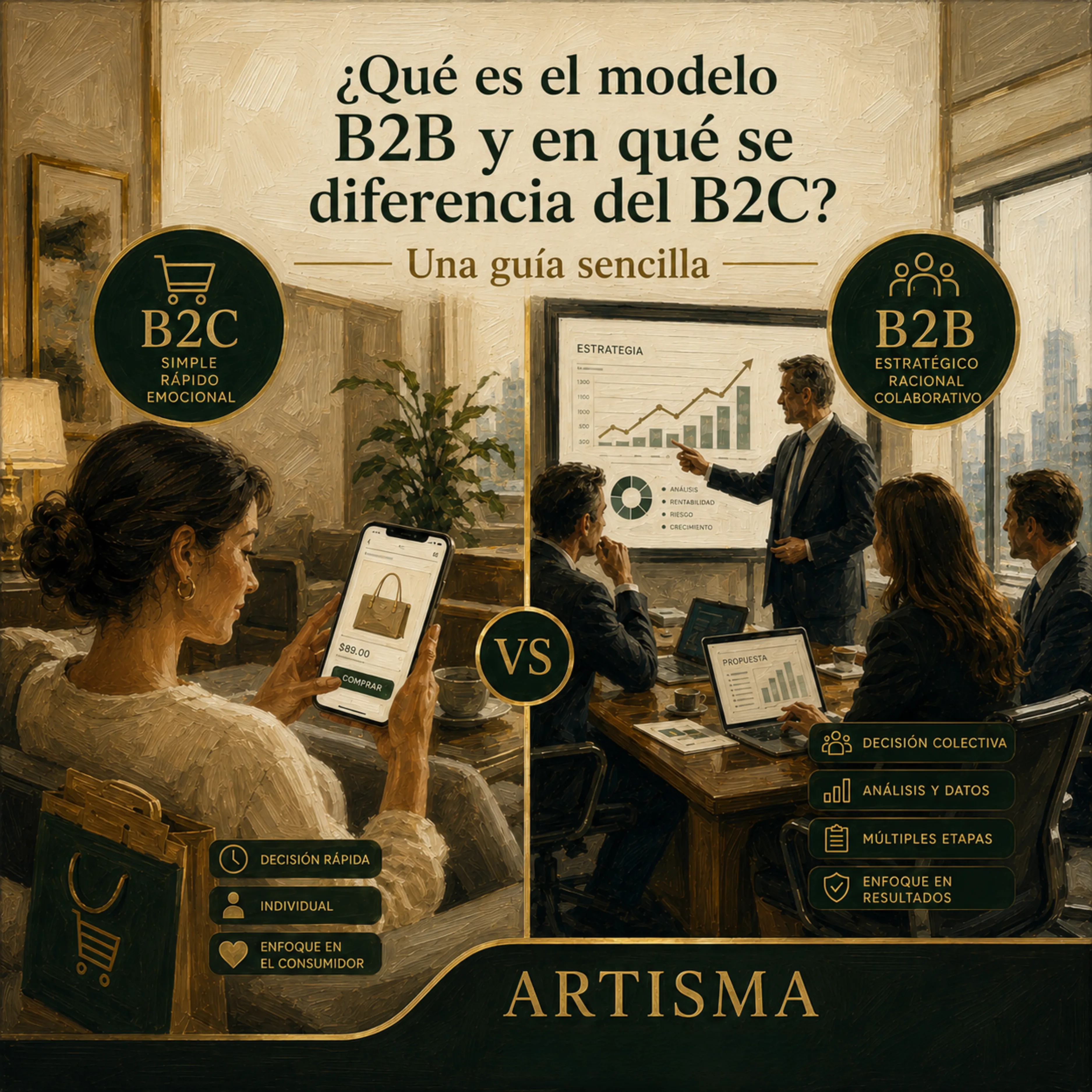
The B2B (Business to Business) model is one in which a company sells products or services to another company, not to the end consumer. It differs from B2C in the buying cycle, the decision-makers involved, the communication channels, and the commercial logic that drives each negotiation.
When the client is another company: the logic that changes everything
Most companies learn marketing by looking at mass consumer brands: television campaigns, seasonal discounts, influencers. That playbook does not work when your customer is not a person at home, but a procurement committee in a boardroom.
The B2B model operates under a different logic. Here, purchases are not made impulsively or driven by the emotion of the moment. Companies buy to solve an operational problem, reduce costs, scale capacity, or mitigate risk. That changes absolutely everything: the message, the channel, the tone, and the patience the sales process requires.
Understanding that difference is the foundation upon which a commercial strategy is built that generates real, sustained, and scalable results, not merely an academic matter.
What exactly is the B2B model?
B2B is the acronym for Business to Business. It describes any commercial transaction in which both the buyer and the seller are organizations, not private individuals.
Some concrete examples of B2B relationships:
- A marketing agency that designs the digital strategy of an industrial distribution chain.
- An ERP software provider that sells licenses to manufacturing companies.
- An HR consultancy that manages recruitment processes for an engineering firm.
- A corporate law firm that advises business groups on mergers and acquisitions.
What unites all these examples is that the value delivered does not go to an end consumer, but feeds the operational, strategic, or commercial chain of another organization.
What is the B2C model and what is its starting point?
B2C stands for Business to Consumer. In this model, the company sells directly to the person who will use the product or service in their daily life.
A supermarket, a streaming platform, an online clothing store, or a delivery app operate under B2C logic. The buyer decides alone or with few external influences, the buying cycle is short, and the trigger is usually emotional, aspirational, or based on immediate convenience.
In B2C, scale matters more than the depth of the relationship. The volume of customers compensates for the low margin per transaction. In B2B, the equation is reversed: fewer clients, higher value per negotiation, and commercial relationships measured in years.
Key differences between B2B and B2C: a comparison table
The following table summarizes the main factors that distinguish both models. For directors and decision-makers who are refining their commercial strategy or evaluating which market makes more sense to compete in, this comparison is the starting point.
| Criterion | B2B Model | B2C Model |
|---|---|---|
| Customer | Company or institution | Individual consumer |
| Buying cycle | Weeks or months | Minutes or days |
| Decision-makers | Committee or multiple levels | One person |
| Average ticket | High (thousands to millions) | Low to medium |
| Commercial relationship | Long-term / contractual | Transactional / one-time |
| Main channel | Consulting, LinkedIn, email | Mass media, e-commerce |
| Purchase motivation | ROI, efficiency, risk | Emotion, price, convenience |
| Volume per transaction | Lower frequency, higher value | Higher frequency, lower value |
The B2B buying process: longer, more complex, more strategic
One of the most relevant differences between both models is the duration and complexity of the buying process. In B2C, the path from first contact to transaction can be measured in minutes or days. In B2B, that same path can extend over weeks, months, or, for high-value contracts, even a year or more.
Why does it take so long? Because in most organizations, a purchase of a certain scale involves several stakeholders:
- The end user, who recognizes the need and submits the request.
- The technical team, which evaluates the suitability of the solution.
- The finance department, which analyzes the budget and expected return.
- Senior management or the procurement committee, which approves or vetoes the decision.
Each of these stakeholders has different criteria, different pain points, and different objections. The B2B supplier's job is to build a value case that convinces all of them, not just the one who raised their hand first.
We call this "consensus selling," and mastering it requires a content, communication, and follow-up strategy that goes far beyond a well-designed corporate brochure.
Acquisition channels: where your customer lives depending on the model
In B2C, the most efficient channels tend to be mass media: broad-reach social networks (Instagram, TikTok, YouTube), search advertising oriented toward transactional purchase intent, and e-commerce with minimal friction.
In B2B, channels change because the buyer is different. An operations director does not browse TikTok looking for industrial machinery suppliers. They research on Google, read industry reports, attend specialized events, ask trusted colleagues for references, and spend time on LinkedIn consuming valuable content.
The highest-return B2B channels include:
- Content marketing and technical SEO to capture high commercial intent searches.
- LinkedIn as a platform for authority, prospecting, and relationship nurturing.
- Segmented email marketing to nurture leads through long buying cycles.
- Webinars and industry events to demonstrate expertise and build trust.
- Case studies and client testimonials that reduce the perceived risk of the purchase.
If your company operates in the B2B space and still allocates most of its budget to channels designed for mass consumers, you are probably generating noise where you need to build authority. This is where a well-executed strategy makes the difference between growth and stagnation.
The role of the long-term relationship in B2B
In the B2B model, the first sale is not the destination. It is the beginning of a commercial relationship that can generate recurring revenue for years. Retaining and expanding existing accounts is usually more profitable than constantly acquiring new clients.
This means that sales, marketing, and customer service teams must work in a coordinated way to keep the value promise active long after the contract is signed. The B2B client who feels well cared for, perceives concrete results, and has a supplier who understands their industry does not just renew. They refer.
At Artisma, we build attraction and conversion strategies designed specifically for the rhythms, channels, and decision-makers of the B2B environment. If you want to align your commercial engine with the reality of your market, we can start that conversation today. Visit www.artismamkt.com to learn about our strategic consulting services.
Conclusion
The B2B model is a commercial ecosystem with its own rules, timelines, motivations, and channels, not simply a "more formal" version of B2C. Companies that try to grow in the business market by applying tactics designed for mass consumers typically achieve mediocre results, not from lack of effort, but from lack of focus.
Understanding what the B2B model is and how it differs from B2C is the first step toward making strategic decisions with greater clarity: where to invest the marketing budget, how to structure the sales team, what content to produce, and which metrics truly matter.
If you are ready to build a marketing strategy that speaks the language of your corporate clients, the Artisma team is here to accompany you in that process.
Frequently asked questions about the B2B model
What does B2B mean in marketing?
In marketing, B2B (Business to Business) refers to the strategies and tactics designed for a company to attract, convert, and retain other companies as clients, rather than targeting the individual consumer.
What is the main difference between B2B and B2C?
The main difference lies in who buys and how they decide. In B2B, the purchase is made by an organization through a rational and collective process, with long cycles and multiple decision-makers. In B2C, the purchase is made by an individual with more emotional criteria and short cycles.
Why is the B2B sales cycle longer?
Because it involves multiple departments and authorization levels within the buying company. Each stakeholder evaluates the purchase from their own angle (technical, financial, strategic), which requires more time to build consensus and trust.
What are the best marketing channels for B2B companies?
The channels with the highest return in the B2B environment include content marketing with technical SEO, LinkedIn, segmented email marketing, specialized webinars, and case studies. The optimal combination depends on the sector, the buyer profile, and the average ticket of the solution.
Can a company operate in both B2B and B2C models at the same time?
Yes. There are companies with hybrid models that sell both to other organizations and to end consumers. However, marketing strategies, pricing structures, distribution channels, and sales teams usually require differentiation for each model to function efficiently.
What is B2B inbound marketing and how does it work?
B2B inbound marketing is a strategy that seeks to have potential buyers reach the company organically, rather than interrupting them with advertising. It is based on creating valuable content (articles, guides, studies, webinars) that answers the questions corporate buyers are already asking, positioning the supplier as a reference authority before the formal buying process begins.