B2B
How Does the B2B Sales Funnel Work and What Should Companies Do at Each Stage?
Equipo Artisma
Agencia de Marketing B2B
The company has been investing in digital advertising for six months. Website traffic grew 40%. Social media has more followers than ever. And yet, sales are not moving. The sales team receives contacts who are not exactly sure what the company does, who ask about price before understanding the value, or who disappear after the first call without a trace. What no one has reviewed is whether there is a coherent strategy to guide those users from the moment they discover the brand to the moment they are ready to buy. Without that strategy, the marketing budget generates visibility but not conversion. The sales funnel is the structure that connects those two moments.
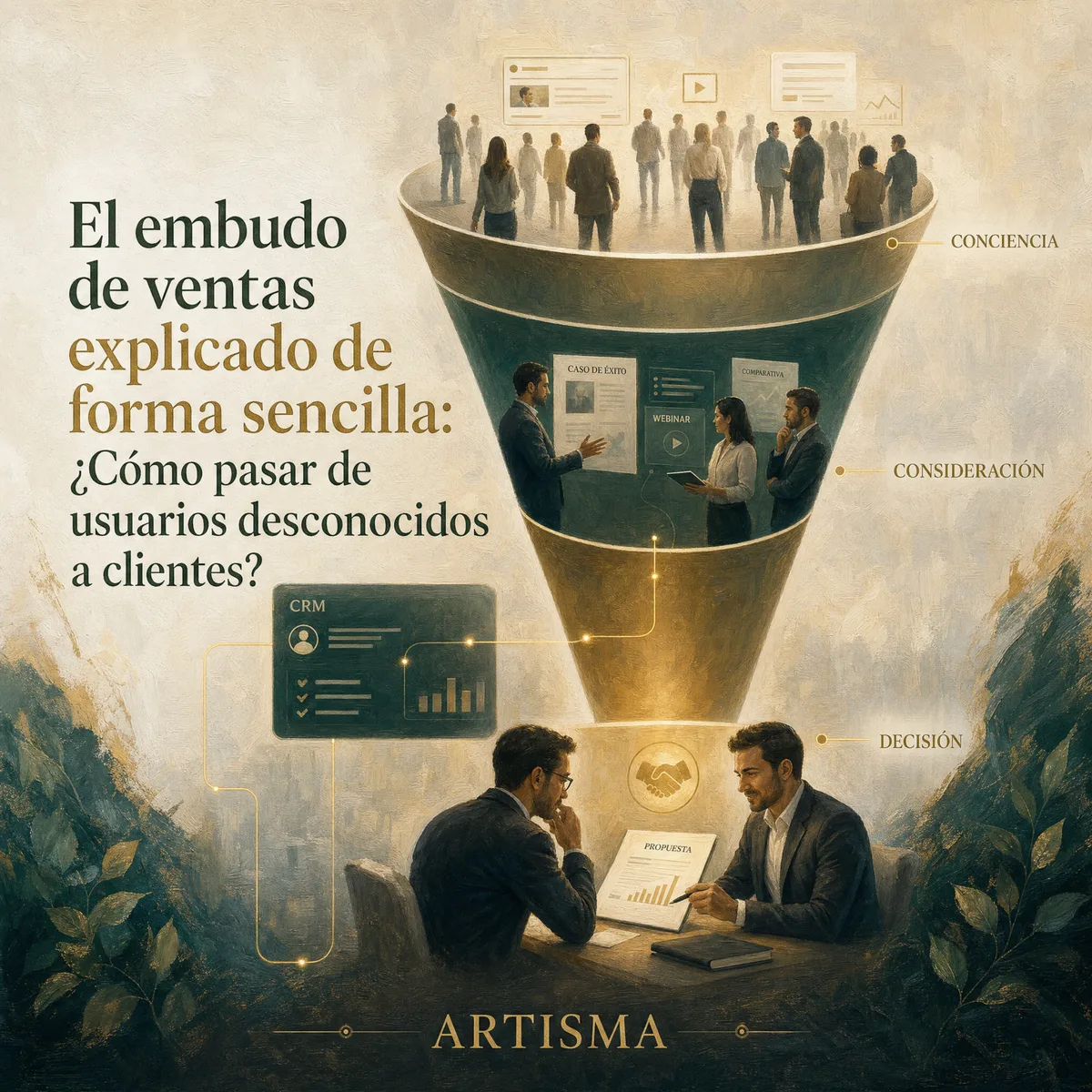
The sales funnel is the model that describes a user's journey from discovering a brand to making a purchasing decision. In B2B it is divided into three main stages: awareness, consideration, and decision. Each one has different content, actions, and advancement criteria.
Why the sales funnel is the map most B2B teams ignore
The concept of the sales funnel has existed for decades in marketing theory. The problem is not that teams do not know it. It is that they do not operate it. Most B2B marketing strategies generate content and campaigns without clarity about which stage of the funnel each piece belongs to and what action is expected from the user who consumes it.
The result is an active but disorganized digital presence: blog articles that talk about pricing before establishing trust, conversion campaigns directed at audiences who still do not know why they need the solution, and sales teams receiving contacts at completely different stages of the process without a differentiated protocol for each one.
At Artisma, we structure the sales funnel as the central axis of any B2B content and growth strategy, not as a diagram in a presentation, but as an operating system that defines what is communicated, to whom, when, and with what objective.
The three stages of the B2B sales funnel and what should happen at each one
TOFU (Top of the Funnel): the user does not yet know they need you
At the top of the funnel are users who have a problem or need but have not articulated it clearly, or who have articulated it but do not yet know the available solutions. At this stage, trying to sell is the most costly mistake a B2B company can make.
What works at TOFU is educational content that helps the user identify and name their problem: blog articles, downloadable guides, explanatory videos, social media posts that generate recognition of the situation. The goal is not for the user to buy. It is for them to trust the company as a reliable source of information about their problem.
The success indicator at this stage is organic traffic, content reach, and the subscription rate to nurturing channels like the newsletter or social media.
MOFU (Middle of the Funnel): the user evaluates their options
At the middle of the funnel, the user already knows they have a problem and is evaluating what solutions exist. Here they compare, research, and analyze. This is the stage where the trust established at TOFU becomes active consideration toward the company.
The most effective content at MOFU helps the user compare with criteria: success stories with concrete results, webinars or product demonstrations, approach comparisons, testimonials from clients with profiles similar to the prospect, and content that addresses the most frequent objections in the sales cycle.
The success indicator at MOFU is the visitor-to-qualified-lead (MQL) conversion rate and the level of engagement with consideration content.
BOFU (Bottom of the Funnel): the user is ready to decide
At the bottom of the funnel is the user who has evaluated their options and is close to making a decision. In B2B, this stage can include multiple interactions with the sales team, the preparation of a technical and economic proposal, evaluation by multiple decision-makers, and formal negotiation.
The most effective content and actions at BOFU reduce the perceived risk of the decision: pilot tests, guarantees, verifiable references from current clients, personalized proposals, and technical demonstrations specific to the prospect's use case.
The success indicator at BOFU is the SQL-to-closed-client conversion rate and the average sales cycle time.
How to connect the funnel stages without losing the user along the way
The point of greatest loss in any B2B sales funnel is in the transitions between stages, not within a single stage. A user who reaches MOFU but does not receive the right content at the right time returns to TOFU or, worse, goes to the competition. An MQL that the sales team does not contact within the first 24 to 48 hours loses buying temperature rapidly.
The operational solution is automated nurturing: communication sequences designed to guide the user from one stage to the next with content relevant to their moment in the process. When nurturing is well designed and the CRM records lead behavior in real time, the sales team knows exactly when to intervene and with what argument.
The most common mistakes that break the funnel in B2B companies
- Generating traffic without a capture strategy: attracting visitors who leave no contact information is investment without measurable return.
- Creating content without assigning it to a specific stage: a blog article that talks about pricing to someone who does not yet understand the problem does not convert. It confuses.
- Passing all leads to sales without qualification: the sales team wastes time on contacts who are not ready and neglects those who are.
- Not measuring the conversion rate between stages: without that metric, it is impossible to know where the funnel breaks and what to improve first.
- Closing the relationship with the client after the sale: in B2B, the existing client is the most efficient source of new opportunities. The funnel does not end at the sale. It continues in retention.
Frequently asked questions about the B2B sales funnel
Does the sales funnel apply equally to all types of B2B companies?
The three-stage structure is universal, but the duration of each stage, the most effective content, and the level of sales team intervention vary depending on the average ticket, the complexity of the solution, and the number of decision-makers involved. A company with high-value sales and long cycles needs a funnel with much more consideration content and a more rigorous qualification process.
How long does it take for a lead to travel through the B2B funnel?
In B2B, the average sales cycle ranges from weeks for low-complexity solutions to months or even years for high-value contracts with multiple decision-makers. The key is not to artificially accelerate the cycle, but to be present at each stage with the right content and communication so the user advances when they are ready.
How is the effectiveness of a B2B sales funnel measured?
The key indicators are the conversion rate between each pair of stages (visitor to lead, lead to MQL, MQL to SQL, SQL to client), the average time at each stage, the customer acquisition cost (CAC), and the customer lifetime value (LTV). When these indicators are monitored on a regular cadence, it is possible to precisely identify where value is lost and which intervention has the greatest impact.