Why Is LinkedIn the Essential Channel for B2B Companies to Connect with Other Businesses?
Equipo Artisma
Agencia de Marketing B2B
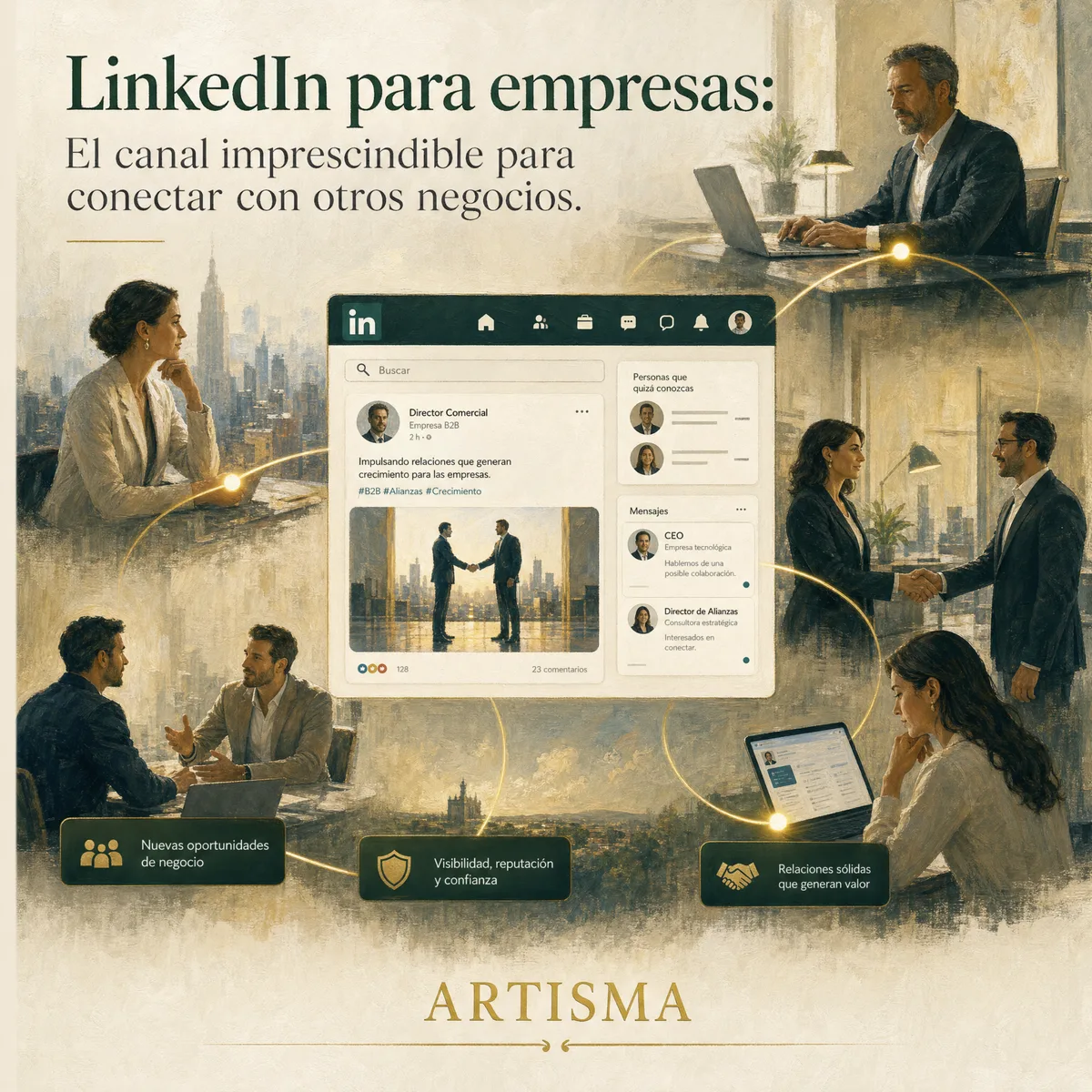
The commercial team has been sending cold emails to a list of prospects for six months, and no one responded. The open rate does not exceed 12% and the replies that do come in are rejections or silence. Meanwhile, the sales director of a competitor publishes weekly on LinkedIn about the specific problems facing the sector, receives connection requests from procurement managers they did not even know existed, and closes analysis meetings with companies they could never have reached through an unsolicited email. The difference is in the channel and how it is used, not in the product or the price.
LinkedIn concentrates more than 80% of B2B leads generated through social media. It is the only channel where decision-makers actively search for suppliers, evaluate technical authority, and accept commercial conversations within a verifiable professional context.
Why LinkedIn reaches the B2B decision-maker when other channels do not
LinkedIn's figures in B2B environments are not a marketing argument. They are a description of real buying behavior. 80% of the B2B leads generated through social media come from this platform. Four out of five LinkedIn users have the ability to influence purchasing decisions within their organization. And, most relevant for companies with long sales cycles: it is the channel where decision-makers actively search for suppliers, not where they feel interrupted by advertising.
The professional context no other network can replicate
When a CEO opens Instagram, they are in entertainment consumption mode. When they open LinkedIn, they are in professional mode: evaluating sector movements, reading about problems their company faces, and reviewing how their peers are solving similar challenges. This context fundamentally changes how they receive a company's content. On LinkedIn, a technical analysis of a real sector problem has inherent credibility. The same information published on another network can look like advertising even when it is not.
For B2B companies selling complex, high-value solutions to buyers who need to be convinced before purchasing, the LinkedIn context is not a minor detail. It is the condition that makes the conversation possible.
Decision-makers are here actively, not just passively
In B2B, the buyer is rarely a single person. The decision process involves directors, department managers, finance leads, and in many cases technical teams. All those profiles have an active presence on LinkedIn and, in most cases, review their feed several times a week looking for information on sector trends, suppliers, and solutions.
A company without an active LinkedIn presence leaves that visibility space to the competitor who does have it. In a B2B sales cycle where the buyer researches between 5 and 7 sources before making a decision, not appearing in the channel where those buyers consume professional information is equivalent to not existing in part of their evaluation process.
How to build a LinkedIn presence that generates real opportunities
Having a company page on LinkedIn is not the same as having a strategy on LinkedIn. The difference lies in how the channel is used: whether it is used to publish corporate announcements or to generate conversations that position the company as a reference point for the problems of its sector.
The company page as a verifiable credibility asset
The LinkedIn company page is, for many B2B buyers, the second verification point after the website. It is where they confirm that the company exists, that it has a real team, that it has been active in the market for some time, and that it has a clear position on the problems they face. An incomplete page, with sporadic posts or no content that demonstrates technical sector knowledge, communicates the opposite: neglect and absence of strategy.
The elements that turn a company page into a credibility asset are: a precise description of the value proposition in sector language (not generic agency language), regular updates on topics relevant to the buyer, and visibility of the human team that backs the company.
Content that positions, not content that announces
The most frequent mistake B2B companies make on LinkedIn is using the channel as a corporate announcement board. Publishing about internal achievements, received awards, or product launches without the context of the problem they solve does not generate conversations. It generates scroll.
What works in B2B LinkedIn is content that positions the company as an authority on the problems its ideal client faces: analysis of sector trends, reflections on common industry mistakes, market change data with concrete implications for decision-makers. This type of content does not ask the reader to buy. It makes them think. And when the reader thinks and recognizes that the company that published that content understands their reality better than anyone else, they initiate the conversation themselves.
At Artisma, we develop LinkedIn content strategies that position our B2B clients as references in their sector before the first formal commercial contact takes place. That prior positioning shortens the sales cycle and elevates the quality of the first contact.
Social selling: turning visibility into qualified conversations
Social selling is the strategic use of LinkedIn to identify prospects, build relationships before formal commercial contact, and generate trust through content and interaction. It does not mean sending cold messages with a sales pitch. It means appearing consistently in the environment where prospects consume information, so that when they are ready to evaluate suppliers, the company is one of the first they consider.
A well-implemented social selling program in a B2B commercial team combines a company page with authority content, personal profiles of commercial executives who publish and comment regularly, and a prospecting protocol that uses LinkedIn Sales Navigator to identify decision-makers and reach them with a previously built context.
The mistakes that neutralize LinkedIn's potential for B2B companies
There are three patterns we frequently observe in B2B companies that have a LinkedIn presence but obtain no measurable commercial results.
The first is publishing without a defined audience. If the content a company publishes is not calibrated for the specific profile of the person who makes purchasing decisions in their sector, it is generating visibility among people who will not buy. LinkedIn allows you to segment audiences with a precision no other B2B social network offers. Not leveraging it means operating in generic broadcast mode.
The second is confusing activity with strategy. Publishing frequently without any post responding to a real problem of the ideal client is activity without return. Relevance matters more than frequency. One post per month that positions the company in a technical debate in its sector generates more opportunities than ten weekly posts with no differentiated content value.
The third is separating the company page from the team's personal profiles. On LinkedIn, the algorithm amplifies content from personal profiles far more than from company pages. An effective B2B LinkedIn strategy integrates both: the company page as the center of institutional credibility and the profiles of leaders and commercial executives as voices that expand reach and generate direct conversations with prospects.
Frequently asked questions about LinkedIn for B2B companies
How often should a B2B company publish on LinkedIn to generate results?
The optimal frequency for a B2B company page on LinkedIn is between 2 and 4 posts per week, as long as the content is relevant to the decision-maker. For the personal profiles of the commercial team, the recommendation is at least 3 weekly posts with active participation in sector content. Consistency matters more than maximum frequency: six months of regular publishing builds more accumulated authority than an intense 30-day campaign followed by silence.
Are LinkedIn Ads necessary if you already have an organic content strategy?
LinkedIn advertising has one of the highest cost-per-click rates in the digital ecosystem, but it also offers the most precise segmentation available for reaching B2B decision-makers by title, industry, company size, and seniority level. For companies with long sales cycles, LinkedIn Ads works best as a complement to the organic strategy rather than a substitute: organic content builds trust over the long term; advertising accelerates contact with qualified profiles who do not yet know the company.
How is the return on a LinkedIn strategy for B2B companies measured?
The most relevant indicators are: number of connection requests received from ideal client profiles, response rate to direct prospecting messages, conversations initiated by inbound from published content, and conversions from LinkedIn contact to analysis meeting. Revenue impact is the ultimate indicator, but the preceding indicators allow you to optimize the strategy in real time without waiting for sales to close to evaluate whether the channel is working.