B2B
How Can B2B Companies Leverage the Hybrid Model Without Losing Strategic Alignment?
Equipo Artisma
Agencia de Marketing B2B
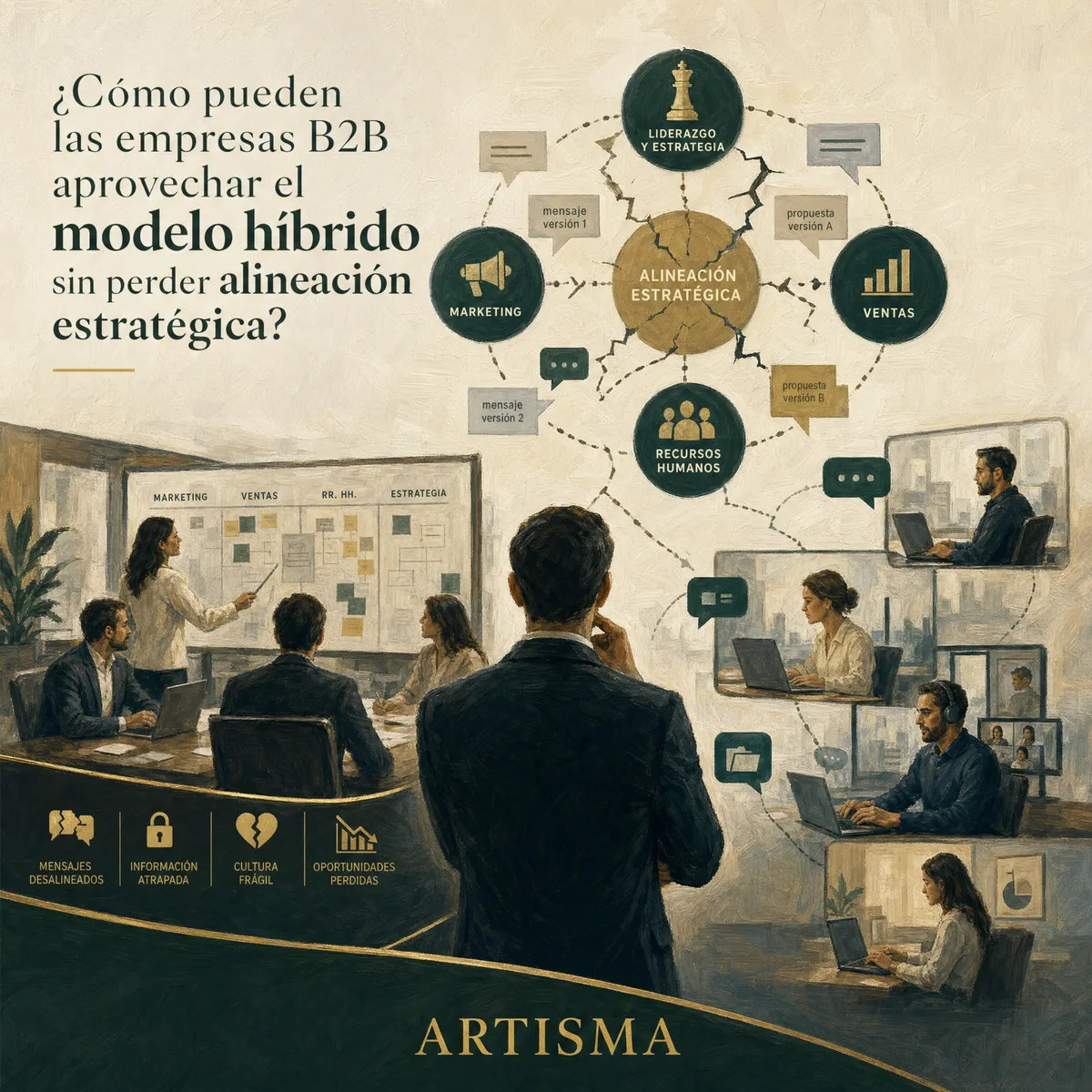
The contract is signed, the client expects results in 30 days, and your sales team just discovered that the marketing department has been working for three weeks on a completely different value proposition. One team operates from home, the other from the office, and no one agreed on a synchronization protocol. The alignment meeting turned into a discussion about who should have communicated what. The result: delayed delivery, erosion of internal trust, and a commercial opportunity at risk. This scenario is, increasingly, the norm in B2B companies that adopted the hybrid model without a clear operating strategy, not the exception.
The hybrid model is viable in B2B when combined with clear internal communication protocols, active smarketing, and an organizational culture that prioritizes alignment over physical presence.
The hybrid model in B2B: when flexibility has no structure, it becomes chaos
Since 2020, hybrid work models have gone from being a temporary concession to becoming the new operating standard for companies. However, adopting hybridity without a solid communication architecture and organizational culture generates direct consequences on commercial performance: duplication of efforts, information silos between teams, and a fragmented customer experience that no sales process can sustain.
At Artisma, we have identified that the B2B organizations that have best navigated this transition share a common denominator: they did not only change where their teams work, but how they communicate, how they make decisions, and how they measure collective success.
The three challenges that most impact B2B operations in hybrid environments
1. The disconnect between Marketing and Sales is amplified
In a face-to-face environment, teams resolve misalignments with a hallway conversation. In the hybrid model, that conversation does not happen spontaneously. The result is what B2B strategy calls smarketing friction: Marketing generates leads with one message, Sales approaches them with a different argument, and the prospect perceives a company that does not speak with a single voice.
Warning sign: when sales teams create their own presentation materials because the marketing ones "don't work for them," smarketing is broken.
2. Information flows between teams become fragmented
In the hybrid model, information tends to concentrate in informal channels: the in-office team's chat, the quick call between those who share the office, the email thread that does not include the remote colleague. This generates knowledge asymmetries that affect decision-making and the speed of response to the client.
A B2B company with long sales cycles cannot afford its Sales Director to be unaware of a product update that the technical team released the previous week. In hybrid environments, that disconnect occurs with a frequency that few executives are measuring.
3. Organizational culture loses cohesion without deliberate intervention
Culture is built through rituals, conversation spaces, and shared experiences, not transmitted by decree. When half the team works remotely, those rituals must be deliberately redesigned, or they simply cease to exist. Endomarketing, understood as the internal communication strategy oriented toward aligning and engaging employees with the company's objectives, becomes the most underutilized and, at the same time, most critical instrument at this stage.
The real advantages of the hybrid model when managed strategically
The well-implemented hybrid model is a tangible competitive advantage for B2B companies that know how to leverage it, not just a concession to employee preference.
- Access to talent without geographic restriction: The best commercial, technical, and creative profiles no longer accept 100% in-person roles if there is no strategic reason for it. B2B companies that adopt the hybrid model expand their capacity to attract and retain specialized talent.
- Greater autonomy, greater productivity: When teams have clarity on objectives, tools, and communication protocols, the flexibility of the hybrid model translates into greater concentration and less time lost in commuting.
- Reduction of operational costs with strategic reinvestment: A portion of fixed infrastructure costs can be redirected toward collaboration technology, training, or value proposition development, areas that directly impact growth.
- Greater regional or multinational response capacity: For B2B companies with clients in multiple time zones or geographies, having distributed teams with clear work protocols is an operational advantage, not a disadvantage.
How to break down silos and optimize information flows in hybrid teams
Implement a smarketing protocol for distributed teams
Smarketing is not just about aligning metrics between Marketing and Sales. In hybrid environments, it means creating a synchronization cadence that does not depend on physical proximity. This includes weekly alignment meetings with a structured agenda, a centralized repository of updated sales messages, and a bidirectional feedback system where Sales reports lead quality and Marketing adjusts its strategy in real time.
Adopt asynchronous communication tools with criteria
It is about defining which channel is used for which type of communication, not about adding more applications to the technology stack. Strategic decisions are not made in chat. Project updates are not communicated by email. Critical documentation does not live in conversation history. Establishing these rules reduces noise, accelerates decision-making, and ensures that all team members, whether in-office or remote, access the same information at the same time.
Activate endomarketing as a cultural cohesion lever
At Artisma, we work with B2B companies to design endomarketing strategies that go beyond the monthly internal newsletter. An effective internal communication strategy in hybrid environments includes training content accessible on any device, recognition spaces visible to all employees, corporate narratives that reinforce shared purpose, and active listening channels that detect friction before it escalates.
When employees understand the why behind each strategic decision and feel they are part of a collective vision, hybridity ceases to be a cohesion risk and becomes an operational asset.
The most effective tools for alignment in B2B hybrid environments
Tools do not replace strategy, but they make it possible. These are the categories with the greatest impact on B2B hybrid operations:
- Project management platforms with full team visibility (Asana, Monday, ClickUp).
- Centralized knowledge repositories (Notion, Confluence) where critical information does not depend on who is in the office.
- CRMs integrated with the marketing stack to ensure Sales and Marketing operate on the same data in real time.
- Asynchronous communication tools with video functionality (Loom, Vidyard) to reduce the volume of meetings without sacrificing clarity.
- Endomarketing and internal communication platforms (Workvivo, Beekeeper, Staffbase) to keep organizational culture active in distributed environments.
Frequently asked questions about hybrid work models in B2B companies
What is smarketing and how is it applied in hybrid teams?
Smarketing is the strategic alignment between Marketing and Sales teams to operate with a unified message, shared objectives, and joint accountability metrics. In hybrid teams, it is implemented through periodic synchronization meetings, centralized repositories of sales content, and a continuous feedback protocol between both areas.
How is organizational culture maintained in a partially remote team?
Organizational culture in hybrid environments requires deliberate intervention through endomarketing strategies: constant internal communication, recognition spaces accessible to all employees, team rituals adapted to digital and in-person formats, and leadership that models the company's values regardless of the work modality.
What are the key indicators for measuring the effectiveness of the hybrid model in B2B?
The most relevant indicators include: alignment rate between leads generated by Marketing and opportunities closed by Sales, internal response time to critical requests, employee satisfaction index (eNPS) by work modality, and sales cycle speed before and after implementing the hybrid model with a defined communication protocol.