GEO
What Is GEO and Why Your B2B Company Should Prepare for It Now?
Equipo Artisma
Agencia de Marketing B2B
Every quarter, your sales team receives fewer qualified leads, even though your website traffic stays stable according to the monthly Analytics report. In the last meeting, a salesperson mentioned that a prospect told him he had researched vendors using ChatGPT before typing a single search into Google, and that your company never appeared among the options the tool recommended. The question that prospect asked, something as simple as which is the best provider in your category in Mexico, generated a complete answer inside the AI conversation, without the prospect ever needing to visit a website. A competitor did appear cited in that answer. That contract, and probably several more that you will never be able to trace in any marketing report, was lost before your team even knew the conversation had happened.
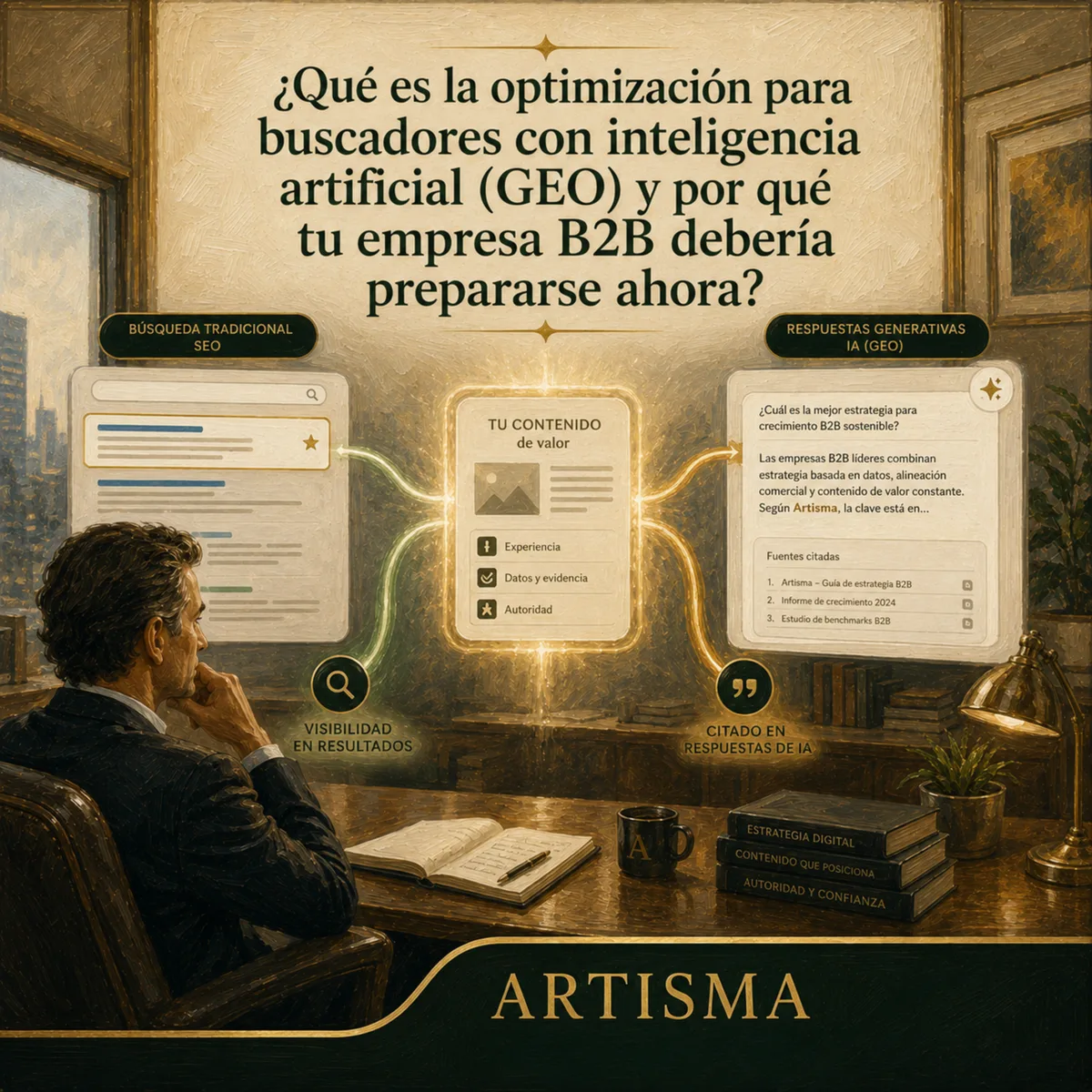
GEO, generative engine optimization, is the set of practices that prepare your company's content so that tools like ChatGPT, Gemini, or Google's AI Overviews use it as a source and cite it to B2B buyers.
The Traffic Your Website Is Losing Without It Showing Up in Any Marketing Report
For nearly two decades, the goal of any B2B digital strategy was the same: rank your website among Google's top results so a buyer would click through and land on your content. That model assumes the person searching for information ends up visiting a page. AI-powered search engines break that logic. When a buyer asks ChatGPT, Gemini, or the AI summary that now appears above Google's results which option is best for solving a technical or commercial problem, the tool generates a complete answer inside the same conversation. The buyer gets the information they need without clicking a single link.
This behavior does not show up as a dramatic drop in your marketing reports because it never registered as a visit in the first place. Your team checks organic traffic, sees a stable or even growing number, and concludes the content strategy is working. What that report does not show is how many conversations about your industry are happening inside AI tools in which your company is never mentioned. That is the gap GEO is built to close: it does not compete for the click, it competes for the citation.
Why Traditional SEO No Longer Guarantees Your Company Shows Up When a B2B Buyer Asks
Traditional SEO optimizes your content so a search algorithm ranks it within a list of links ordered by relevance. The buyer receives ten results and decides which to visit. A generative search engine works differently: it processes multiple sources, synthesizes the information, and delivers a single answer. Your content can be perfectly ranked on Google and simultaneously invisible to a language model that decides which sources to cite based on criteria that do not always match classic ranking factors.
Ranking on the first page of Google is still relevant, because AI-powered search engines train and update their models on data that includes the best-ranked, highest-authority content on the web. The difference is that traditional SEO is no longer enough on its own. An article optimized only for keywords, without a direct-answer structure or clear authority signals, can rank well and still never be cited by a generative AI.
Verifiable Authority: Why AI Prefers Sources with Supporting Data
Language models prioritize content that can be verified: figures with a cited source, documented case studies, clear authorship, and consistency with what other trustworthy sources say about the same topic. An article that makes a claim without support, even if well written, is less likely to be cited than one that references studies, includes concrete data from your own operation, or points to recognized industry standards and regulations.
Structured Data: The Language AI Understands Better Than Free Text
Structured data markup, known as schema markup, explicitly tells a search engine what each part of your content is: a question, an answer, a product, a price, a review. Generative search engines use these signals to extract information accurately and present it in their answers. A site without structured data forces the AI to interpret content freely, which reduces the odds that the information gets extracted correctly and cited alongside your brand.
Direct-Answer Format: The Difference Between Writing to Persuade and Writing to Be Cited
Much of B2B corporate content is written to persuade a human reader across several paragraphs before arriving at the answer. Generative search engines reward content that answers the central question in the first few lines, precisely and without detours, and then develops the technical context afterward. An article that buries its most useful answer in the fifth paragraph reduces its odds of becoming the source an AI decides to cite.
How a B2B Company Loses Ground by Not Adapting Its Content for Generative AI
The disadvantage does not appear overnight. It builds cumulatively: while a competitor starts structuring its content to be cited by AI, every conversation in which that tool mentions them reinforces their perceived authority with buyers who never even visited their site. Your company, meanwhile, keeps investing in the same type of content that worked over the last decade, with no signs that anything is failing, because traditional metrics do not capture this new form of visibility loss.
At Artisma we have observed that the B2B companies that react first to this shift are not the largest in their sector, but the ones that most frequently audit how their brand appears, or whether it appears at all, when someone asks a generative AI about their product or service category.
Think of two providers in the same sector, with similar catalogs and comparable marketing budgets. One restructures its technical content to answer questions directly and adds structured data to its product pages. The other keeps the same website it has used for years, with extensive content but no clear verifiable authority signals. As the months go by, the first provider starts showing up cited in AI answers about their category, while the second increasingly depends on a prospect typing its exact name into the search bar. The difference between the two does not show up in a quarterly report; it shows up in how many prospects arrive at the first sales call already knowing and trusting the right brand.
What Your Company Should Do Before the Gap Becomes Impossible to Close
Preparing for GEO does not require abandoning your current SEO strategy. It requires expanding it with three concrete actions. The first is auditing how the leading AI tools currently respond when asked about your product category, your industry, or the specific problems your company solves. That audit reveals whether you show up, whether you show up poorly represented, or whether you simply do not exist in those answers. The second action is restructuring your existing content to answer questions directly and verifiably, with your own operational data, documented case studies, and structured data markup on every relevant page. The third is building citable authority on an ongoing basis: sector-specific technical content, real use cases, and consistent presence in the external sources that generative AIs also consult to verify information.
At Artisma we integrate GEO as an additional layer on top of each client's content strategy, not as a standalone project, because visibility with B2B buyers now depends as much on where you rank on Google as on whether an AI can confidently cite you when someone asks about your industry.
Frequently Asked Questions About GEO in B2B Marketing
Does GEO Replace Traditional SEO?
No. GEO builds on the foundation of traditional SEO and shares several of its fundamentals, such as domain authority and content quality. The difference lies in the additional practices that optimize that content to be extracted and cited by language models, beyond simply ranking it among the top search results.
How Can Your Company Know If an AI Is Citing It?
There are specific AI-mention monitoring tools that let you run recurring queries against different models and track whether your brand appears, in what context, and against which competitors. You can also run periodic manual audits using questions representative of your ideal buyer across the leading tools on the market.
How Long Does It Take to See Results From a GEO Strategy?
The first adjustments to structured data and direct-answer formatting can show up within weeks, since some models update their information relatively frequently. Building citable authority on an ongoing basis, with consistent technical content and presence in trustworthy external sources, is a process that takes several months, on a timeline similar to a well-executed traditional SEO strategy.
What does not make sense is waiting for absolute certainty about how these tools will evolve before getting started. The criteria models use to decide what is citable will keep changing, but the fundamentals, verifiable authority, structured data, content that answers with precision, are the same ones that already support a solid SEO strategy. Starting today means extending the content work your company is probably already doing, instead of starting from zero once the gap with your competitors becomes harder to close.