Asistente virtual
Chatbot vs. Contact Capture Virtual Assistant: What Differs
Equipo Artisma
Agencia de Marketing B2B
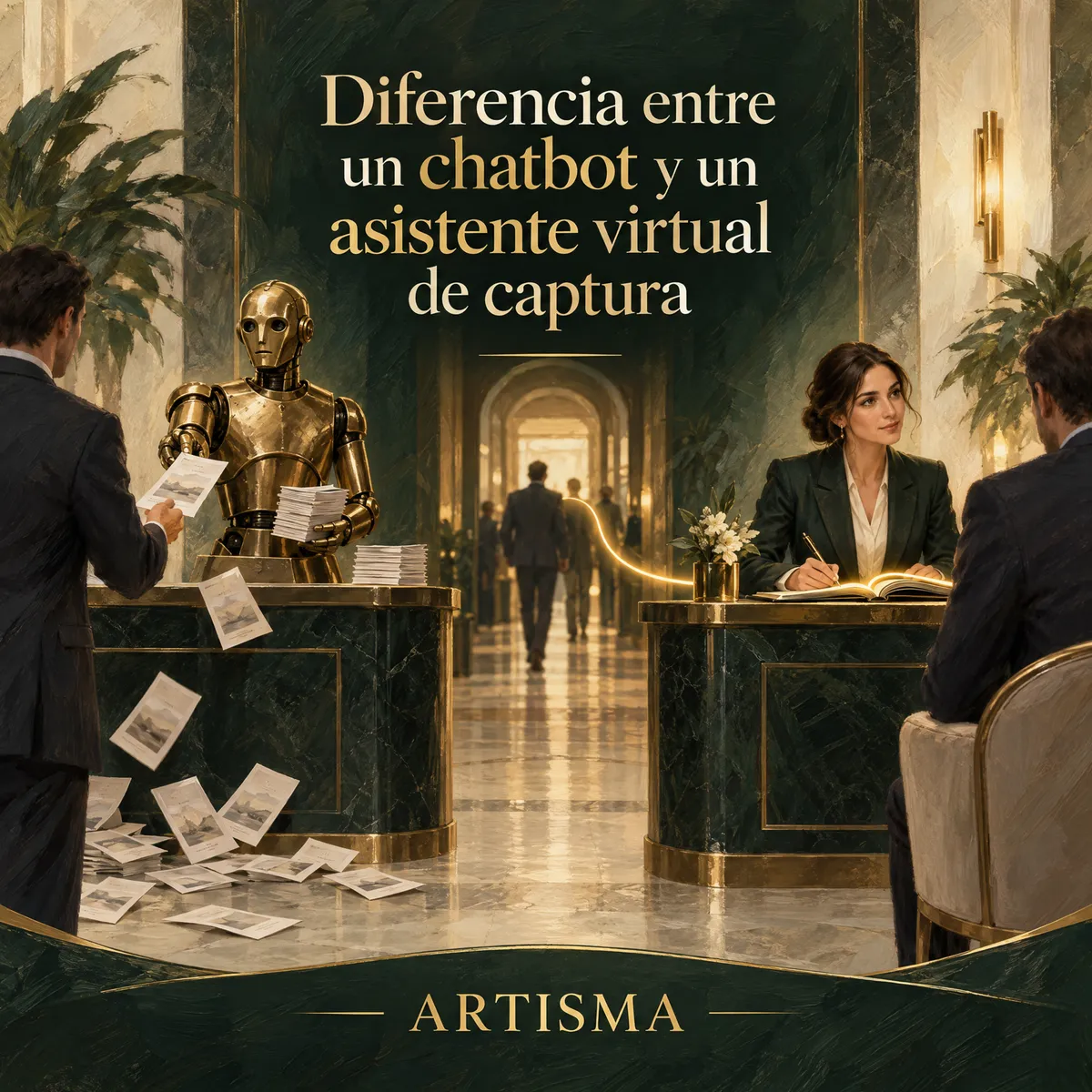
Your company installed a chat widget on the site six months ago and the inbox keeps filling up. A maintenance supervisor writes at eleven at night to ask whether your equipment runs on 440 three phase power, and the chat hands him a menu with three options that do not include his question. He tries again, the system repeats the menu, and on the third attempt he types that he wants to talk to a person; at that point it asks for his email with the promise that someone will get in touch. That email lands in a shared inbox nobody checked over the weekend, and by Monday the project has already been quoted by another supplier.
A chatbot answers anticipated questions with scripted replies. A contact capture virtual assistant steers the conversation toward qualifying the visitor and delivers the contact, with its context, into your commercial process.
Why Two Tools That Look Identical Produce Opposite Results
On screen, both tools appear as a bubble in the lower right corner of the site. The difference lives underneath that bubble: what each one can answer, where it steers the conversation and what finally reaches your sales team. That difference explains why two companies with comparable investments get different commercial results.
The Decision Tree Behind a Chatbot
A traditional chatbot runs on a decision tree, a closed set of anticipated questions with their answers written in advance. The visitor picks an option from the menu, the system returns the associated text and offers the next menu. That design works very well when the questions are repetitive and narrow: hours, location, order status, the service department phone number. The limitation shows up the moment a visitor phrases something the tree does not cover. The bot repeats the menu, offers a generic contact option or asks for an email with the promise that someone will reply. Each of those three endings returns the visitor to the exact spot they were in before they typed anything.
The Conversational Qualification Behind a Capture Assistant
A contact capture virtual assistant runs on your company's real information and with an explicit commercial objective: understand what the visitor needs and take them through to registering their contact details with that context attached. It answers open questions about services, scope, industries and timelines, and at the same time identifies qualification signals in what the visitor writes, such as the type of company, the urgency of the project or the equipment they already have installed. The conversation moves toward a concrete commercial action and the record it produces enters the system where your team works. The purpose of each tool is what sets them apart: one is designed to resolve service questions, the other to feed your sales process.
The Four Differences That Show Up in the Monthly Sales Report
Scope of the Answers
The chatbot answers within the catalog someone loaded into it. If your company adds a product line or changes a delivery timeline, that change does not exist for the tool until someone enters it by hand. The capture assistant works from a knowledge base built from your commercial and technical documentation, and it handles phrasings nobody anticipated, because it interprets the intent of the question instead of looking for an exact match. For an industrial buyer asking about voltage compatibility, tolerances or line capacity, that difference decides whether they get an answer or leave the site.
Where the Contact Ends Up
The typical chatbot leaves the conversation in the tool's own message inbox or forwards it to a shared email address. That destination depends on someone opening the panel and checking it in time. The capture assistant sends the contact to the CRM or the commercial system your company already uses, with an owner assigned and the conversation attached. Where the contact ends up is the difference that shows most clearly at month end, because it determines how many of those conversations turned into an opportunity with an owner and a follow up date.
The Information Your Rep Receives
From a chatbot, your rep usually receives a name and an email tagged as an information request. The call starts from zero and repeats questions the visitor already answered, which with a technical buyer leaves the impression of internal disorder. From a capture assistant, that same rep receives what the visitor asked, which page they were on, which service they looked at and what technical constraint they mentioned. The first call picks the conversation up where it left off, with the full context in view.
Traceability of the Conversation
The accumulated conversation history has commercial value in its own right. A menu based chatbot records which options people chose, useful information for adjusting the menu. A capture assistant records the real questions of your market, in the buyer's own words, ahead of every quote. That record shows which objection keeps recurring, what information is missing from your site and what content is worth publishing next quarter, backed by evidence of how your prospects actually behave. After a quarter of operation, that history becomes the cheapest input your marketing team has for deciding which pages to write and which arguments to prepare for the sales team.
When Each Tool Makes Sense at a B2B Company
The Scenario Where a Chatbot Works Well
A chatbot does its job in operations with a high volume of repetitive, low unit value queries: order tracking, service hours, branch locations, billing questions. At a company with ecommerce or high volume after sales service, the chatbot takes work off the support team and instantly answers what would otherwise occupy a person for hours. If your volume of operational queries is high and your sale does not depend on a prior technical conversation, the chatbot is proportional to the problem you actually have.
The Scenario Where a Chatbot Costs You Prospects
The problem appears when a manufacturing, industrial machinery or enterprise software company installs a chatbot expecting it to generate prospects. In those sectors, the question that arrives through chat is almost never in the menu, because it concerns a specification, a compatibility issue or a particular scope. The visitor left without that answer walks away with the impression that your company will not have it over the phone either, and the evaluation continues without you. With long sales cycles and committee purchasing, every conversation lost in the chat represents an opportunity that never got recorded in any report.
The Mistake of Installing the Tool Before Defining the Process
The choice between one tool and the other comes down to an earlier question: what should happen after the visitor types something. If the answer is deliver a fact and close the conversation, a chatbot is enough. If the answer is identify an opportunity, qualify it and hand it to a rep with context, the tool needs to be connected to your funnel and your CRM from its first day of operation.
Across the projects we review, the pattern repeats: the tool got installed in an afternoon and the commercial process behind it was never defined. Nobody agreed on who reviews the conversations, within what timeframe, by what criteria a contact counts as qualified or which system it enters. With that gap, either tool produces the same outcome, which is a full inbox and an empty funnel. The right order starts by agreeing on the response commitment, the qualification criteria and the system where the contact lives, and only then choosing the technology that supports that agreement.
At Artisma we build the contact capture virtual assistant into B2B website redesigns, connected to visitor analytics, to the funnel's calls to action and to your company's CRM. Before configuring it we define the commercial process that will support it together with you, because that is where the outcome gets decided.
Frequently Asked Questions
Can I Start With a Chatbot and Migrate to a Capture Assistant Later?
Yes, with one condition: that you define from the start which system the contacts enter. A chatbot that leaves six months of conversations in its own inbox forces you to redo the work when you migrate. If the data flow into your CRM is settled from the beginning, changing tools becomes an adjustment rather than a new project.
Can a Virtual Assistant Give Technical Information Without Getting It Wrong?
It answers using the documentation your company loads and within the limits you define for it. A correct configuration includes establishing which topics it hands off to a person: formal quotes, critical tolerances and contractual commitments. An assistant that recognizes its limit and transfers in time builds more trust with a technical buyer than one that improvises an answer.
Which One Suits My Company If the Site Gets Few Inquiries?
With a low volume of inquiries, the priority is the content and the structure of the site, because a conversational tool only works with the visits that already exist. When those visits do arrive, the capture assistant makes the most of every one, which matters even more when traffic is limited.